
Key Takeaways
- The majority of "best AI tools for fashion" lists are, in fact, roundups of creative tools. These image generation- and design-related tools comprise one category only rather than representing all possible aspects.
- Fashion AI basically gets divided into four fields: creative production, commerce and catalog operations, customer experience, and trend or demand intelligence. Each of them targets different areas of the company.
- The area of trend and demand forecasting can often generate the largest financial return. However, clean sales data are essential for that level to work well. The generation of images is not.
- When you choose a tool, ensure that the workflow of your team is not interrupted, that the tools connect to the platforms you are already using, and that the vendor is reliable and built to endure.
- The suitable first AI investment must correspond to the bottleneck of a brand at the present moment rather than to the most popular tool on the market this month.
Why Most "Best AI Tools for Fashion" Lists Don't Help You Choose
The major part of the published lists of products is actually aimed at the needs of a solo designer. Image editing, sketch-to-digital, virtual try-on. These tools photograph well and are straightforward for content, so writers keep returning to them.
That is indeed a legitimate category. It's a piece of the picture showing how AI can help fashion businesses on a daily basis. The only thing that you really care about is not "which is the best AI tool." You are really asking, "What kind of problem am I trying to fix?" If it's that kind of knowledge that you would have, then choosing a vendor becomes very easy.

To demonstrate the effect of creative tools, content writers have to use before-and-after images since they tell a story in one screenshot. The forecasting dashboard that saves you from a markdown three months from now would hardly qualify as exciting content to write about.
Therefore, the forecasting layers might not be discussed much. On the contrary, they are usually essential. It is difficult to market money-saving tools through a listicle, and so they get less attention than they actually deserve.
The Four Areas Where AI Actually Shows Up in a Fashion Brand
Currently, nearly every technology that claims to be Fashion AI fits into one of the four types discussed here. If you know which one you need most, you can save months of trial and error on the wrong solution.
Creation and Design
Sketching in 3D, AI photography of products, images with a model, virtual try-on. These are the types of tools that cut down your expenses for photo shoots and allow you to think about and create new ideas faster.
These are quick to work and are visually pleasing in demos. These kinds of products don't influence decisions like inventory levels or timing of markdown offers, which are usually done from the demand side.
Commerce & Catalog Operations
Listing product descriptions at scale, automating product data including taxonomies, multi-channel publishing. Their worth escalates as catalog size increases, and the layer remains unseen by clients, although the effort you save in manual work on your team adds up really quickly.
Customer Experience
Personal assistants that are powered by AI, tailored suggestions, and assistance post-purchase that includes return of goods and order tracking. This part of the business directly affects how many people get converted into buyers, as well as customer support costs. Its effectiveness is fully dependent on how well the customer/product data is used.
Trend, Demand & Inventory Intelligence
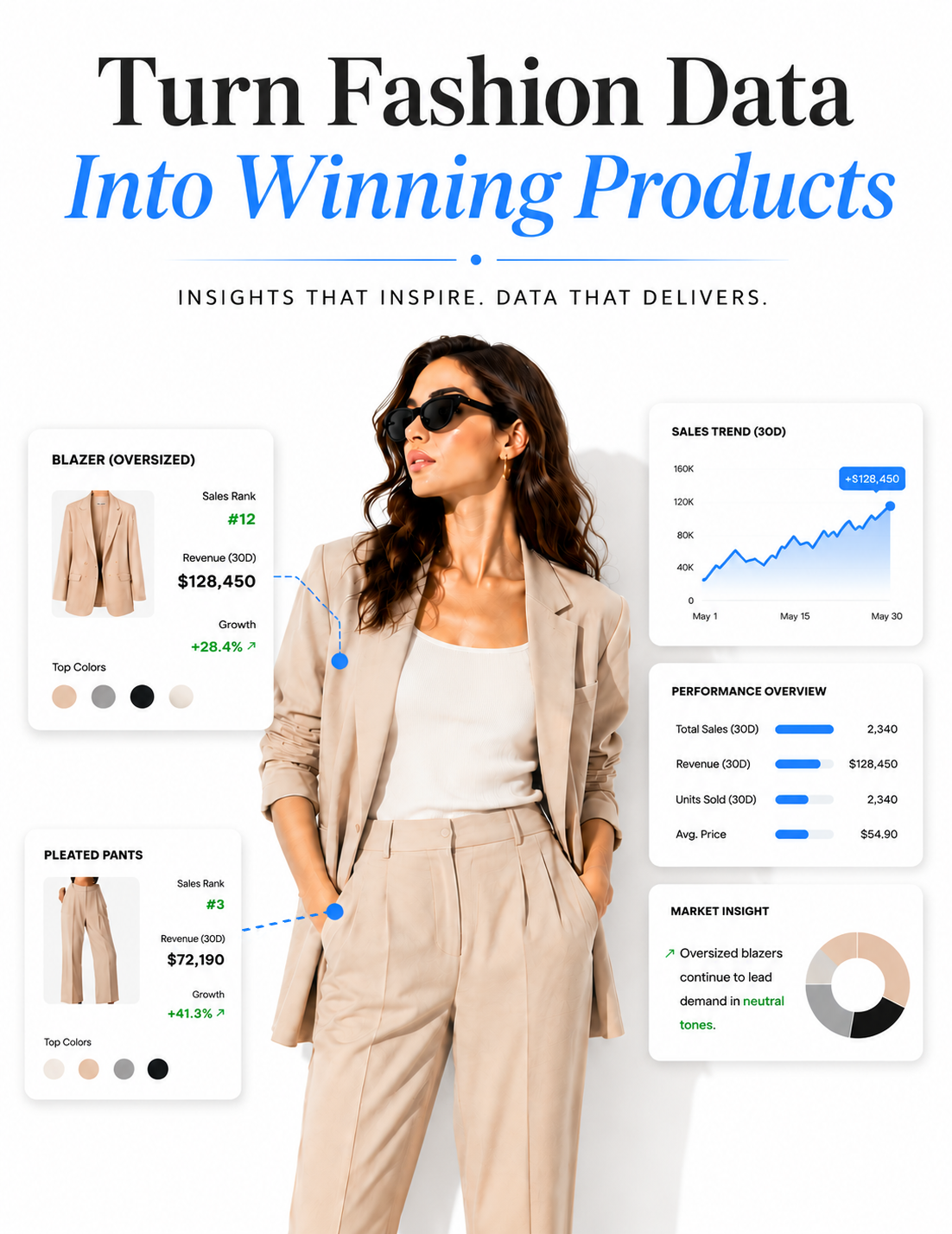
Identification of trends through color, silhouette, competitor assortments monitoring, demand predictions, stock planning, and optimization. Sometimes this area leads to the biggest financial benefits as it decreases the amount of excess inventory and the frequency of markdowns. The reason this area is mostly skipped is that it can't be presented well with a screenshot. Garmio Trend Finder, Competitor Monitor, and Market Insights sit within this area of the category among several other options.
A single wrong purchase decision can easily outweigh all subscription charges if one purchases a product not popular at a quantity that one is not able to sell.

The racks of markdowns, warehouse space, and capital tied up in stock are only a few of the things that result from a bad inventory purchase decision that lacked the necessary signals. The purpose of this layer is to provide an added signal so that a buying manager or a merchandiser can make the most informed possible budget decision before actually committing to spend, not to take away their role entirely.
Which Layer Do You Decide to Use First?
Your level of progress as a business and the areas of difficulty that exist now are what make the difference, not popular stuff on social media now.
- A brand is at a small scale or one that's just starting - It's the time when creative tools, like product image editing or a minimal content setup, would give you the fastest, cheapest win since there is no need yet for forecasting AI.
- A company grows beyond the level of the first few seasons - it comes down to the forecast layer and the market. Here's when buying too many stock items and heavy markdowns result in big money loss.
- A brand with more channels and a larger product assortment than before - the layer of catalog and commerce automation is the one to invest in once manual tasks of listing start slowing you down too much.
- Talking volume of support increasing at a higher pace than the growth of your team - It has to do with trying out one of the customer experience and support automation layers.
These stages will eventually have their own timeframes, and a fashion company that starts off with creative tools in launching will definitely have a higher need for forecasting and trend intelligence.
Questions to Ask Before You Adopt Any Fashion AI Tool
Ask these questions before the deal is signed, not at the end.
- Does it fit how your team works? A tool designed for use by one designer will quickly generate friction once a project has to be approved by more than one person. So it's not just about the demo, but also ask how the multi-review process is implemented.
- Does it connect to what you already use? The question of whether Shopify, Etsy, or WooCommerce integration will determine whether a tool is incorporated into your workflow or turned into another forgotten tab.
- Does the data it needs already exist in your business? The sales and customer data you provide to forecasting and personalization tools is the main driver of their usefulness. An excellent tool might still let you down if you have not yet gathered that data.
- What's the real payback, not just the subscription cost? A more expensive tool that helps you save money on markdowns will be a better value than one that only helps you save a few hours a week at a lower cost. Take into consideration how much the problem itself costs. Don't just compare it with the subscription fee.
Comparison: Matching AI Categories to What They Actually Solve
| Layer | Solves | Watch out for |
|---|---|---|
| Creative/Design | Photoshoot costs, ideation speed | Texture and fabric rendering still weak on complex materials |
| Commerce/Catalog | Manual listing time at scale | Needs structured product data to work well |
| Customer Experience | Conversion, support cost | Personalization quality capped by data cleanliness |
| Trend/Demand Intelligence | Overstock, markdowns, buying decisions | Needs enough sales history or market signal to stay reliable early on |
Common Mistakes Companies Do When Picking AI Tools
These tiny errors can add up quickly and lead to huge costs down the line.
- You invest solely in the first layer, which is the creative ones, and just by that you say "we did AI adoption", ignoring the fact that inventory, your biggest cost center, wasn't even touched.
- You select an AI tool only on the basis of a nice demo instead of putting the tool to a real test with your product lines and workflow.
- You implement a forecasting or personalization tool without your underlying data being clean enough that the tool will deliver useful results.
- You go ahead and buy a tool without running the integration process, so there is no connection with your existing systems.
- You sign the annual contract without running a short pilot on real product lines.
- You have only one of your team take the lead on the decision even though you know that, in fact, three departments will be the ones to be using the tool every single day.
The key cause behind these errors is the same: picking a tool without having clearly defined the problem. Once you get that right, most of these mistakes won't happen to you anymore.
A Simple Framework for Making the Decision
Adhering to these steps will help you avoid most of the unnecessary spending that brands often encounter.
- Identify your present largest cost or bottleneck in operations. It might not be the category with flashy AI.
- Link that bottleneck to one of the four layers that were discussed before.
- From that layer only, identify one or at max two tools.
- Assess each shortlisted tool for a product category or a channel against the four adoption questions.
- In the pilot phase, keep it small, limited to one category, one channel, before you decide to implement it widely.
- Create a date when, after 60 or 90 days, you are going to evaluate whether or not the tool has moved the metric that it was introduced for.
Bottom Line
It is hard to find "the best" AI solution for a fashion brand as there are so many options, each matching a specific layer. So, if you know that is the case, go back to the very beginning where this article was started: get a clear picture of your problem and only after that consider shopping around tools to address your problem.
For instance, when the bottleneck is making purchasing and inventory decisions on the basis of gut feeling without data, then it belongs to the trend and demand intelligence layer. Garmio's Trend Finder and Market Insights tools are there to help you decide whether to stock up on one item versus another by showing you data on what is trending and what is selling. Find out how Garmio can improve your buying decisions.
Frequently Asked Questions
What's the difference between AI design tools and AI trend forecasting tools for fashion brands?
AI design tools make images while AI trend tools tell brands what sells. One is about speed. The other is about smart orders.
How much should a small fashion brand budget for AI tools?
Start with a small budget. Monthly fees are $20 -$200 for any size catalog. Based on your brand size, for the forecasting tools, ask them later for their cost.
Can a small or early-stage brand realistically use demand forecasting AI, or is that only for larger brands?
Yes, small brands can use some trend analysis with rivals and current market data. Real demand forecasting requires a few seasons of sales records.
Will AI trend data replace a buyer's or merchandiser's judgment?
No, AI helps buyers but does not replace their judgment about what fits the brand or its customers' wants.
What data do I need before an AI forecasting or personalization tool will actually work well?
Structured past sales records, product features, and customer behaviors are essential; unclear categories and missing items lower accuracy rates no matter how good the AI.
Do I need a different AI tool for design versus for inventory and demand decisions, or is one tool supposed to do both?
Usually, different tools for design compared with inventory forecasts work better, as each type has its own focus.
Related Reading
- How to Scale Brands with Organic Virality and Garmio's Trend Data
- How to Find Profitable Fashion Niches with Competitor Data
- 15 Best Print-on-Demand Apparel Suppliers for High-Quality Custom Clothing (2026)
- The Hidden Math of Fashion Pricing: How to Price Your Products at 4x COGS (and Actually Sell Out)
- The 2026 Guide to High-Margin Fashion Dropshipping: Top Suppliers + The AI Strategy to Out-Style the Competition
Written by Garmio
Garmio provides fashion market intelligence for sellers who need clearer product, trend, influencer, and competitor signals before making inventory decisions.
Editorial note: This content supports research and decision-making. It does not guarantee sales, forecasts, fit outcomes, return reductions, or business results.