
Key Takeaways
- Print on demand gives you an opportunity to test a design or a very limited collection without any risk of inventory. On the downside, a per-unit profit would be less than from bulk manufacturing.
- The quality and how well a brand can be incorporated vary a lot. Not all POD suppliers are "just print a logo on a blank shirt."
- POD suppliers such as Inkedjoy and Printful have genuine white-label features, inner labels, hangtags, and custom packaging, which make them stand out as an alternative for private labels.
- The place of origin of a supplier directly impacts your shipping expense and customers' unboxing experience.
- Identify the supplier's main advantage, e.g., embroidery, all-over print, or premium fabric, and match it with a product you have already verified. Don't begin with the catalog.
Compare the Best Print-on-Demand Apparel Suppliers
| Supplier | Best For | Starting Price | Branding / White-Label | Fulfillment Regions | Etsy/Shopify Integration |
|---|---|---|---|---|---|
| Printful | Embroidery & realistic previews | Free, Growth $24.99/mo | Inside/outside labels, custom packing slips | US, EU, Mexico, Japan | Yes, both |
| Inkedjoy | Affordable white-label at scale | Free, Branding from $19.90/yr | Custom labels, packing bags, hangtags | China, US warehousing | Yes, both |
| Printify | Comparing print providers | Free, Premium $39/mo($24.99/mo annual) | Depends on chosen provider | 100+ providers worldwide | Yes, both |
| Gelato | Local/global fulfillment | Free, Gelato+ ~$24/mo | Branded inserts, packing slips | 30+ countries | Yes, both |
| CustomCat | Fast US turnaround | Free (per-order pricing) | Neutral packaging, limited inserts | US only | Yes, both |
| Contrado | Premium fabric & sublimation | Free to install | Full branding station, sewn labels available | UK, US, worldwide shipping | Yes, both |
| Custom Ink | Bulk & fundraiser orders | Custom quote | Design support, no per-unit dropship branding | US (48 states) | No, direct quote only |
| Teelaunch | Curated niche catalog | Free (per-order pricing) | Packing slips, logo inserts | US | Yes, both |
| Prodigi | Print quality for artists | Free (per-order pricing) | Limited branding tools | 50+ global facilities | Yes, both |
| Gooten | High-volume API sellers | Free (per-order pricing) | Branded packing options | Global network | Yes, both |
| Apliiq | Sewn woven labels & streetwear | Free (per-order pricing) | Woven labels, embroidered patches, 3D puff | US | Yes, both |
| Fourthwall | All-in-one creator platform | Free, per-sale fee | Custom labels, packaging, no MOQ | US, EU | Yes, plus native storefront |
| TapStitch | Fashion-on-Demand, heavyweight blanks | Free (per-order pricing) | Neck labels, hangtags, inserts | US | Yes, plus TikTok Shop |
| TPOP | Sustainable, eco-friendly | Free, Growth €30/mo | Recycled packaging, custom inserts | France, limited US reach | Yes, both |
| Redbubble / TeePublic | Testing designs, zero storefront | Free (marketplace model) | None, marketplace controls branding | Global | Marketplace, not a store integration |
The Best POD & Custom Apparel Suppliers, Reviewed
We've chosen the best suppliers based on their ability to solve various problems for entrepreneurs. You can start right away by reading each product description to identify the best match for you.
1. Printful: Best for Embroidery and Realistic Previews
- Price: Free plan, Growth $24.99/mo (free once you hit $12K in annual sales)
- Fulfillment: US, EU, Mexico, Japan
- Branding: Inside labels ($0.99), outside labels ($2.49), custom packing slips at no cost
- Product range: 455+ items
- Integrations: Shopify, Etsy, WooCommerce, and 30+ platforms
Printful is directly involved in factory work rather than outsourcing it. It gives you much better, consistent order print quality, which is a big advantage if reviews are a part of your marketing strategy.
Printful's embroidery is the best out there, and the fee for turning designs into embroidery is only between $2.95 and $6.50 per design, which is not too bad! Mockup tools are also so realistic that you are going to love them, and then your order is ready. If you are thinking that Printful doesn't know about branding, take a look at their branding options: print inside label, hangtag, and pack slip printing are completely free.
Recently, Printful and Printify both have been acquired by the parent company Fyul. However, both still operate as separate entities with their own products and pricing.
Pros:
- Because production is an internal function of Printful, the quality of orders will be more consistent.
- Near-perfect embroidery and super realistic mock-ups
- Tote bags, packaging, and labels, custom printed
Cons:
- Compared to Printify-style marketplace brands, Printful's prices tend to be on the higher side
- Storage for branded products requires a $25/month minimum
- Growth plan discount only really works at large production volume level
2. Inkedjoy: Best for Affordable White-Label Branding at Scale
- Price: Free plan is offered along with the Branding Lite package at $19.90/year
- Fulfillment: Manufacturing from China but with US warehouses.
- Branding: Your custom labels, printed bags, hangtags, and gift cards
- Products: 1,500+
- Integrations: Shopify, Etsy, WooCommerce
Inkedjoy has directly maintained a relationship with the factory since 2015; this is a main reason why their greatest achievement and a great sacrifice are their very unique product features. With their base costs significantly lower compared to Western POD platforms, the catalog also includes dresses, swimsuits, baby clothes & pet gear, which is a big bonus.
A branding project has been created particularly for clothing retailers, and it's their main feature. You could design and print your custom inside labels as well as packaging with no requirement of minimum order which is great news for a bold brand that wants everything of the garment from the first touch point of unboxing to have the label that the customer will never have to see on another product.
Pros:
- There are hardly any platforms in the POD space with a product selection that wide, with over 1,500 units.
- You may print your custom labels and packaging without having to worry about minimum orders.
- Compared to Western POD suppliers, the unit rates or the base costs of the items are very low.
Cons:
- Fewer reviews & brand awareness than competitors like Printful or Printify.
- Quality reports of the print might vary quite a lot with different product categories.
3. Printify: Best for Comparing Print Providers on Price and Location
- Free plan; Premium $39 monthly or $24.99 quarterly due upfront.
- 100 or more print providers throughout regions.
- Branding hinges on the provider selected.
- The product line has over 900 items available with integrations like Shopify, Etsy, and WooCommerce.
Printify operates as a marketplace of print providers offering flexibility. A Gildan 5000 tee's base price starts at about $8.80, which drops down considering the premium option. However, quality shifts across different providers; thus, ordering samples before committing to bestsellers is necessary here, unlike single-factory platforms.
Premium's monthly fee increased from $29 to $39 in February 2026, while annual billing stays at $24.99 for the ones remaining above a couple of months.
Pros:
- Largest catalog breadth of any major POD platform with over 900 products available.
- Ability to compare pricing plus shipping speed together with providers per product within the platform.
- Free plan is truly usable without requiring any credit card.
Cons:
- Quality along with shipping consistency varies according to the provider fulfilling orders.
- Branding options depend solely on chosen providers.
- Premium's monthly price rose 34% in early 2026.
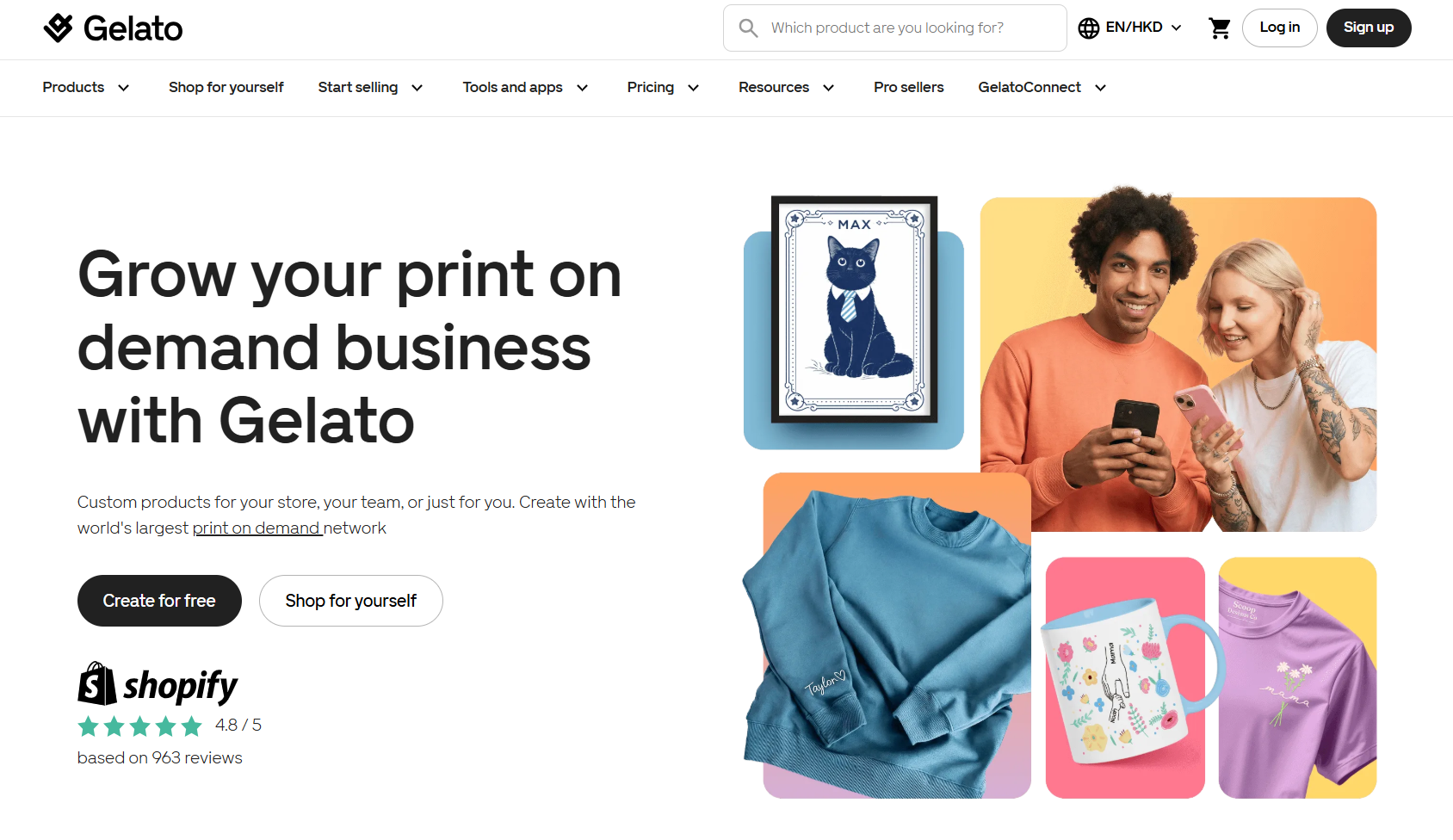
4. Gelato: Best for International and Local Fulfillment
- Free plan, Gelato+ approximately $24 monthly (about $19.99 yearly)
- Fulfillment available from 130+ facilities in over 30 corresponding countries
- Branding by using branded inserts and custom packing slips
- Product range comprises apparel, wall art as well as home decor
- Integrations such as Shopify, Etsy together with other major platforms
Gelato routes every order to the nearest production hub; thus, about 87% of prints are made within the country where buyers live. The situations entails lower delivery time that also reduces international shipping costs.
Sizeable's apparel catalog isn't as wide compared to Printful's, whilst branding tools are less effective. Gelato earns its spot based on speed plus reach rather than catalog depth.
Pros:
- Local production across 30+ countries reduces international shipping time.
- Transparent pricing as well as reporting regarding sustainability.
- Strong choice for wall art and home decor together with apparel.
Cons:
- Smaller apparel catalog than that of Printful or Printify.
- Branding options are fewer, and customization is lighter.
- Not every product has the cheapest base price.
5. CustomCat: Best for a Large Catalog with Fast US Turnaround
- Cost is zero, only pay on the orders
- For shipments; Fulfillment Center only located in Detroit, USA
- Branding style; Plain packaging; In-the-lot limited inserts
- Denominations; More than 500 products
- Supported platforms; Shopify, Etsy, WooCommerce
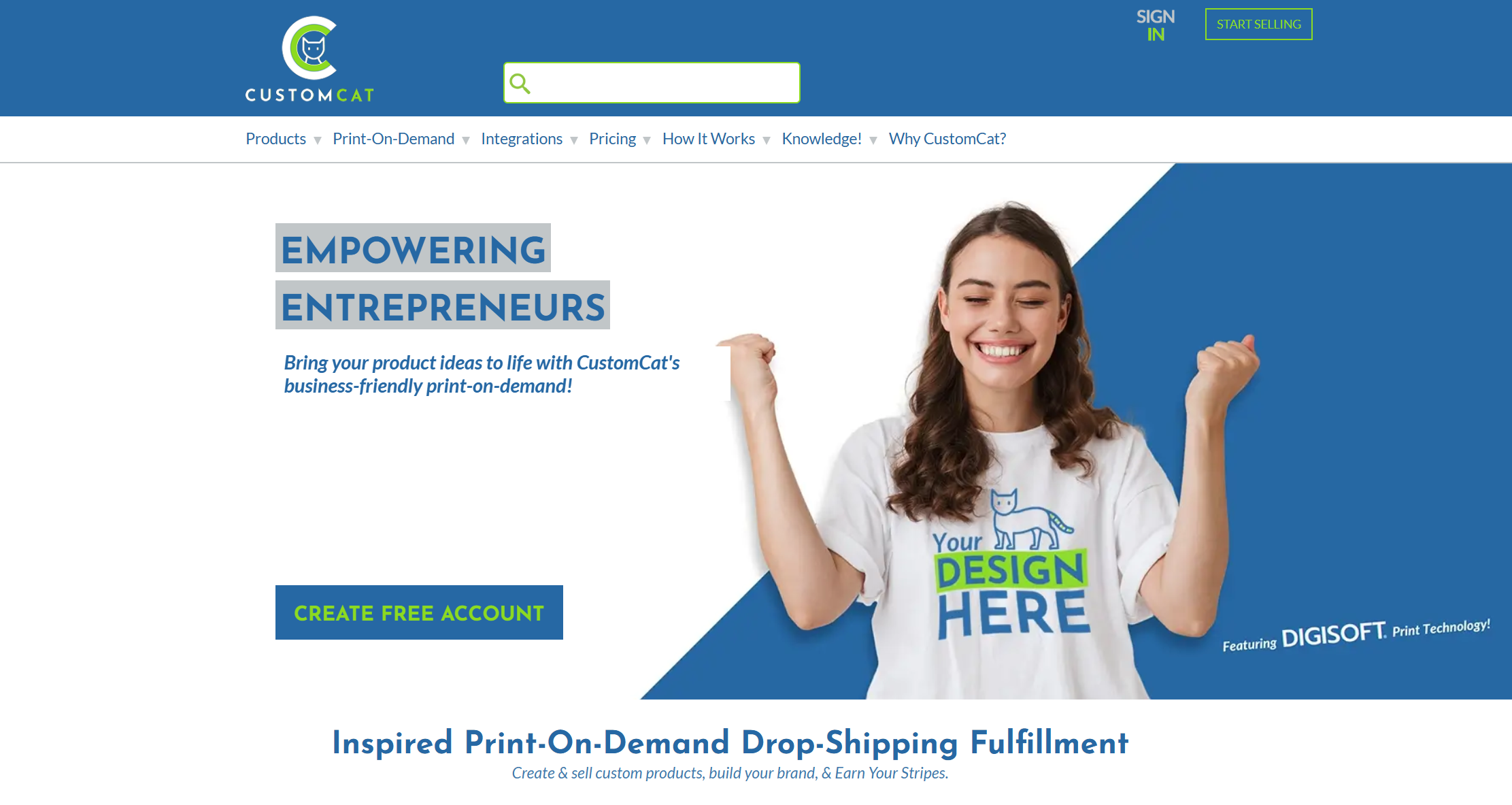
Since its inception in 2012, CustomCat has been fulfilling orders within the US. It is renowned for its fast shipping speed, which allows most domestic orders to be shipped in one to three business days. This is quicker than a majority of print-on-demand competitors.
CustomCat's catalog includes T-shirts, hoodies, caps, and home goods that are DTG printed, embroidered, and dyed sublimated that give apparel-heavy stores various printing methods without needing to use multiple suppliers. Moreover, the pricing is competitive, thus increasing the profit margin for high-volume products.
Pros:
- Fast US turnaround (typically one to three business days)
- Competitive base pricing for apparel
- Wide variety of print methods available (DTG, embroidery, sublimation)
Cons:
- US production results in higher costs and delays for international orders
- Limited branding options compared to premium suppliers
- Support available only during business hours
6. Contrado: Best for Premium Fabric and Sublimation Quality
- The price setup consists of zero charges for installation; Payment is made based on each order
- UK as the base for fulfillment covering the whole globe
- Branding: Full branding station; Sewn labels on some items
- Products range from 450 to 470
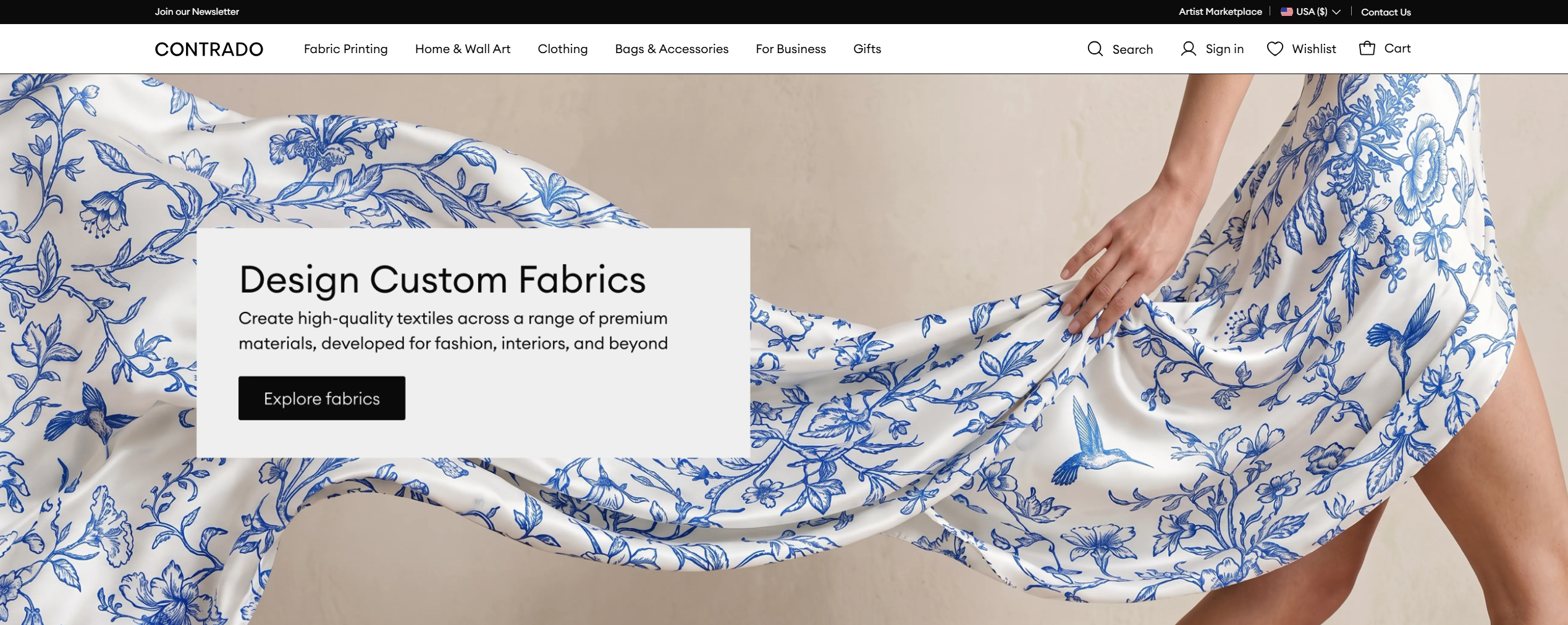
Contrado does true cut-and-sew manufacturing instead of just printing on ready-made items. The designs are printed directly onto different materials like silk, cotton, satin, and velvet using various methods such as reactive, pigment, or dye sublimation. After this process, they will then be cut and stitched out according to in-house designs.
This process results in very high-quality finished products, especially in terms of edge-to-edge prints that show texture comprehensively and color depths not achievable with DTG. Most fabrics take about 48 hours from the start of production to the end without minimum order requirements.
Pros:
- True cut-and-sew production; Premium fabrics available
- No minimum orders; Handmade-level quality
- Full branding station includes sewn labels on some products
Cons:
- Costs per unit, which exceeds that of any other suppliers listed here
- Most suited for premium retail, not budget stores
- Smaller catalog specific to apparel compared to mainstream POD platforms
7. Custom Ink: Best for Bulk and Fundraiser-Style Orders
- Pricing depends on custom quotes made for each order
- Only situated in the US (48 contiguous states)
- Branding setup consists of a design support team with no per-unit white-label option
- Products focus mainly on apparel, thus screen print and digital print
- No integrations available; direct quotes and ordering process
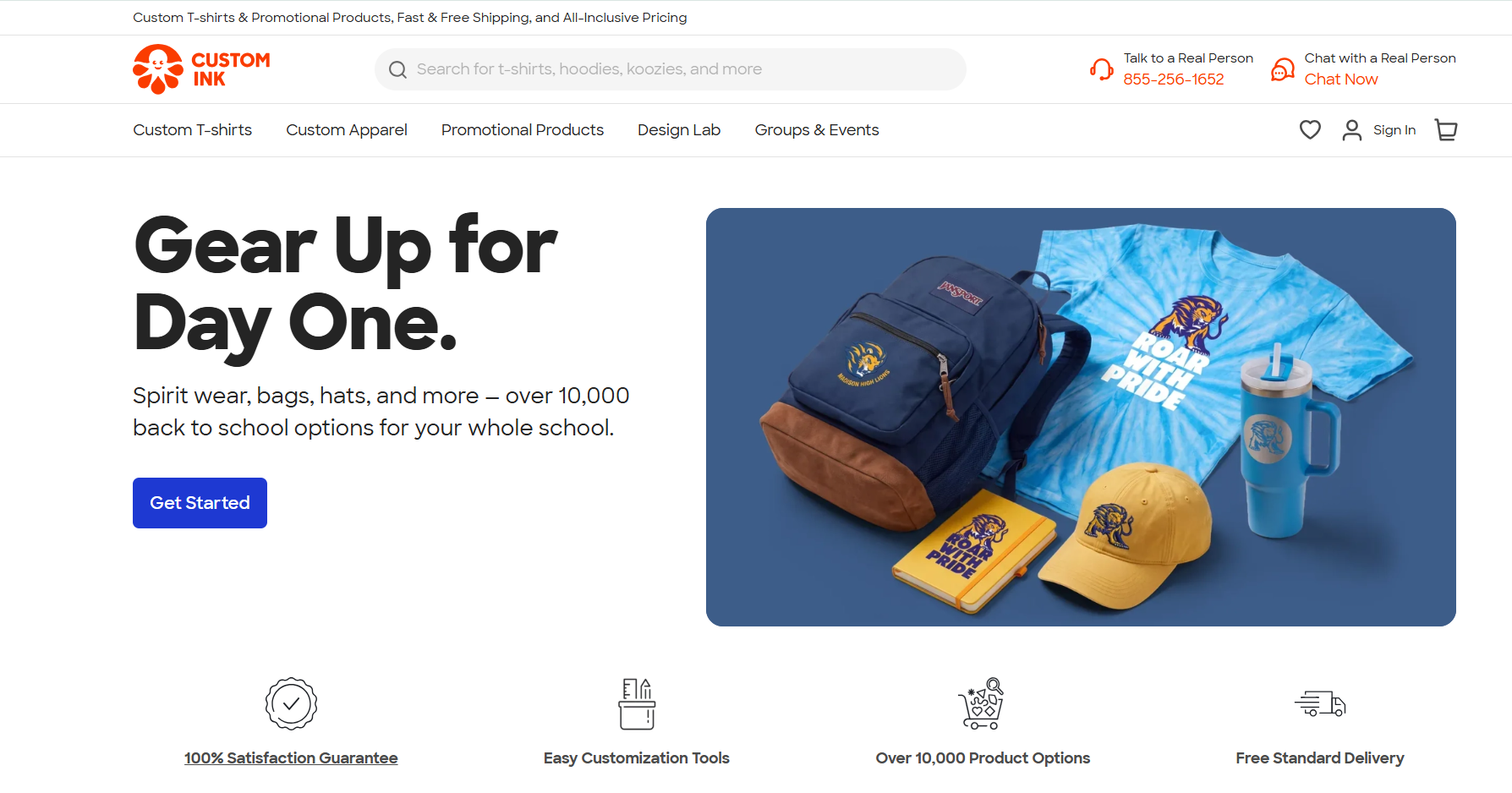
Custom Ink isn't designed for per-unit dropshipping; hence shouldn't be compared with Printful or Printify on that ground, as it serves group orders such as class shirts, race tees/merch & fundraising, where larger orders lead to bigger discounts.
Over 90% of their shirts utilize screen printing, which delivers superior quality colors & coverage on dark fabrics, especially for large-scale reprints.
Pros:
- Screen printing quality excels regarding bulk dark fabric orders.
- Strong design support team assists with one-off group requests.
- Guaranteed delivery times are attached to all quoted orders too.
Cons:
- Not tailored towards per-unit e-commerce or dropshipping.
- No integration with Shopify or Etsy available.
- Only covers US territory for fulfilling requests alongside its custom quoting system elsewhere.
8. Teelaunch: Best for a Smaller, Curated Catalog Inside Shopify
- Price: Free plan (per-order pricing)
- Fulfillment: US-based
- Branding: Packing slips, logo inserts
- Product range: 200 to 300+ items
- Integrations: Shopify-native, plus Etsy and TikTok Shop
Teelaunch has catalogs that cover items most places skip, including special gifts and accessories as well. The app works only on Shopify, making setup and order sync easy.
It's run by the same people behind Printful, but has totally different products and prices. For sellers who want just a few weird items among their usual clothes, that's appealing.
Quality control isn't as good as Printful or CustomCat, and there are few outside-shop connections. Use it as an extra supplier, not your only one.
Pros:
- Areas other places don't offer: unique gifts and jewelry
- Cost-free; pay per order
- Easy to set up orders directly through Shopify
Cons:
- Quality control isn't as good as top rivals
- Limited to Shopify and Etsy
- Fewer products available overall
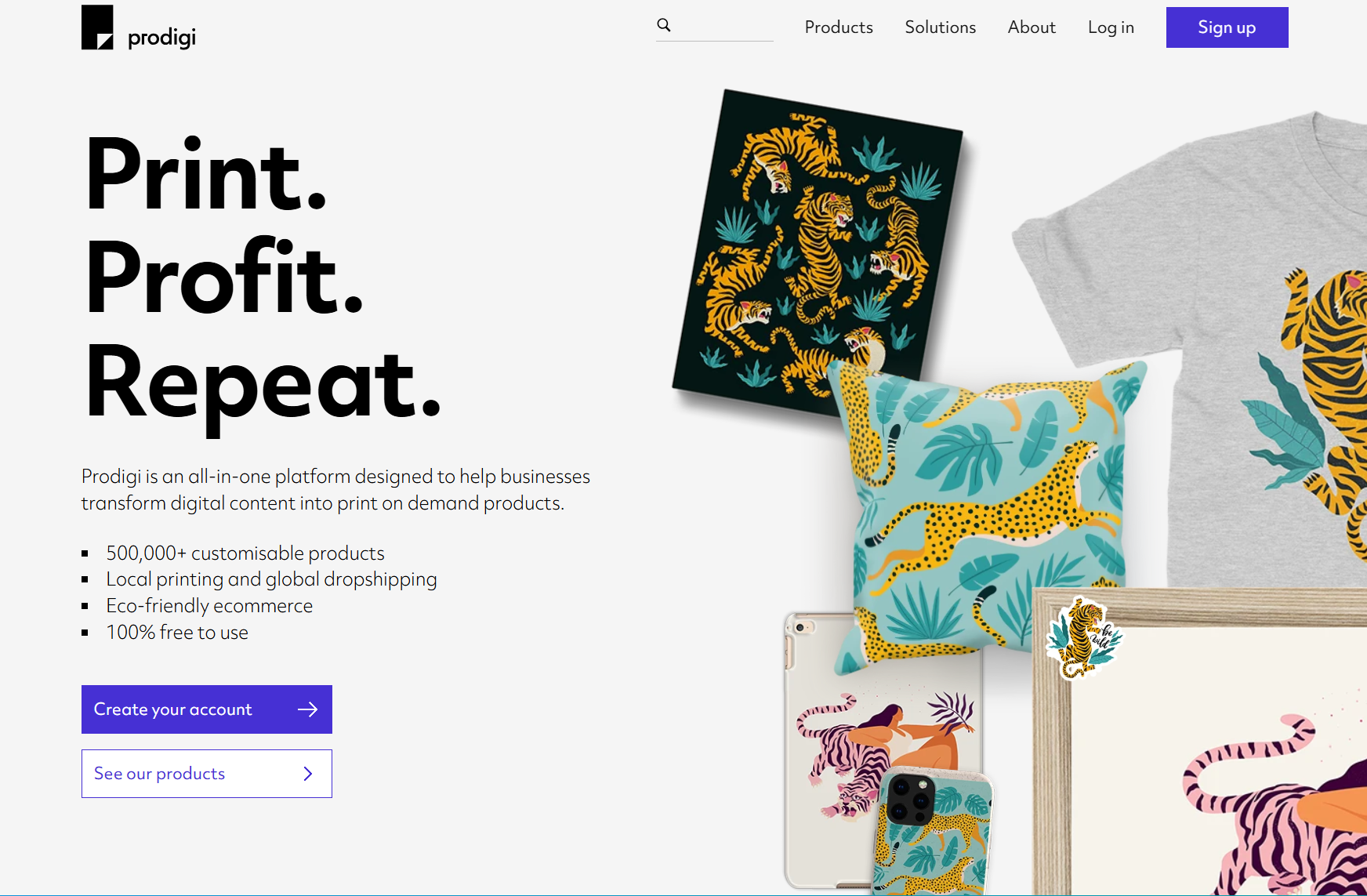
9. Prodigi: Best for Photographers and Print-Quality Purists
- Price: Free (no setup fees)
- Fulfillment: 50+ facilities-located worldwide
- Product range: 500,000+ SKUs, mostly wall art and photo products
- Integrations: Shopify and Etsy; no native Amazon or eBay.
What makes Prodigi stand out is its accuracy in colors. It ensures fabrics retain their colors just as they should for big prints, giving customers framed artworks alongside garments of the same brand.
Its catalog has more variations than the number of clothing items, coming from wall art sizes and frames rather than raw sorts of apparel. There's no commitment entailed, thus easing testing.
Being mainly an apparel seller would've been difficult, but it's perfect for stores that combine a few clothes with art prints, posters, or photo-based merchandise.
Pros:
- Print quality around fine art/photography
- No setup fees/monthly charges
- Wide size&format variety across products
Cons:
- Fewer types of clothes than regular apparel suppliers
- No native link with Amazon/eBay
- Fewer branding tools than Printful/Fourthwall solutions.
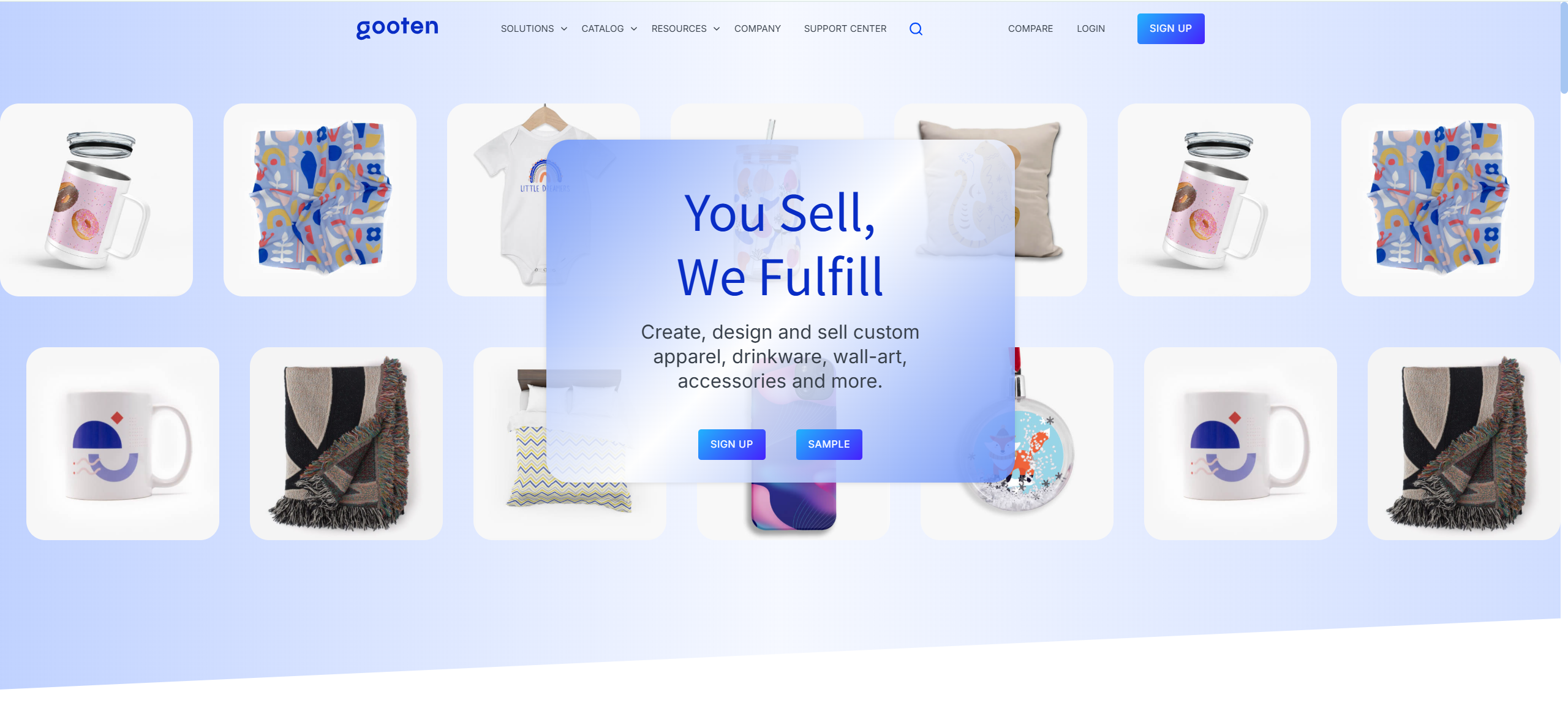
10. Gooten: Best for High-Volume, API-Driven Sellers
- Price: Free (no upfront or recurring fee)
- Fulfillment: Global network|
- Product range: 450+ items
- Integrations: Shopify, Etsy, TikTok Shop, WooCommerce, API.
Gooten handles many units-as much as 22 million since 2019. API access is what attracts stores needing custom ordering logic beyond normal POD setups.
Lesser-known products give room for stores to diversify beyond T-shirts and mugs while maintaining competitive volume pricing with scalable discounts as orders increase.
If you want deep technical control, Gooten is a strong platform for the long term; yet not ideal for beginners looking for the simplest way of doing things.
Pros:
- Direct API access for customized order routing
- Diverse fast-growing product catalog
- Discounted pricing at high volumes
Cons:
- Less beginner-friendly than most competitors' applications
- Weaker branding than offers focusing on premium products
- More technical setup required when using the full API capability.
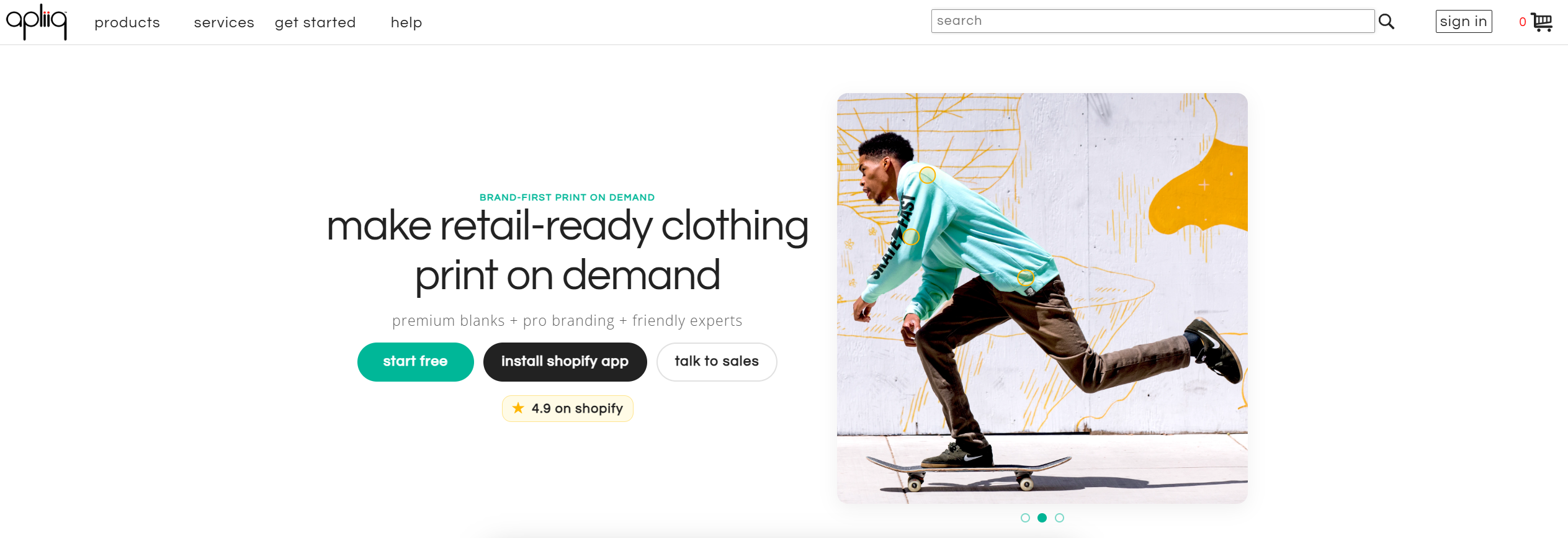
11. Apliiq: Best for Sewn Woven Labels and Streetwear Brands
- Price: Free (per-order)
- Fulfillment: limited to US-based
- Branding: Real sewn woven labels, embroidered patches, 3D puff print, chenille
- Product range: Streetwear apparel aimed up toward 490 gsm
- Integrations: Shopify; Etsy.
Apliiq has woven labels sewn into garments rather than printed, thus affecting how premium-feeling products are when someone touches their inside labels, particularly important for streetwear brands.
Heavy-weighted blanks, over many competitors' offerings, and a deeper branding stack comprising embroidered patches as well as puff prints plus chenille detailing make it suitable for manufacturing specific ones.
Despite only catering to the local market, hence limited international reach among others, Apliiq becomes worthwhile if inside collar feels matter most.
Pros:
- Only major supplier with true sewn woven labels available.
- Heaviest blank weights possible among competitors.
- Deep branding stack including patches, puff prints, and chenille.
Cons:
- US-only fulfillment, thus limiting international reach.
- Restricted catalog breadth compared to general-purpose platforms' offerings.
- High unit costs due to premium branding options.
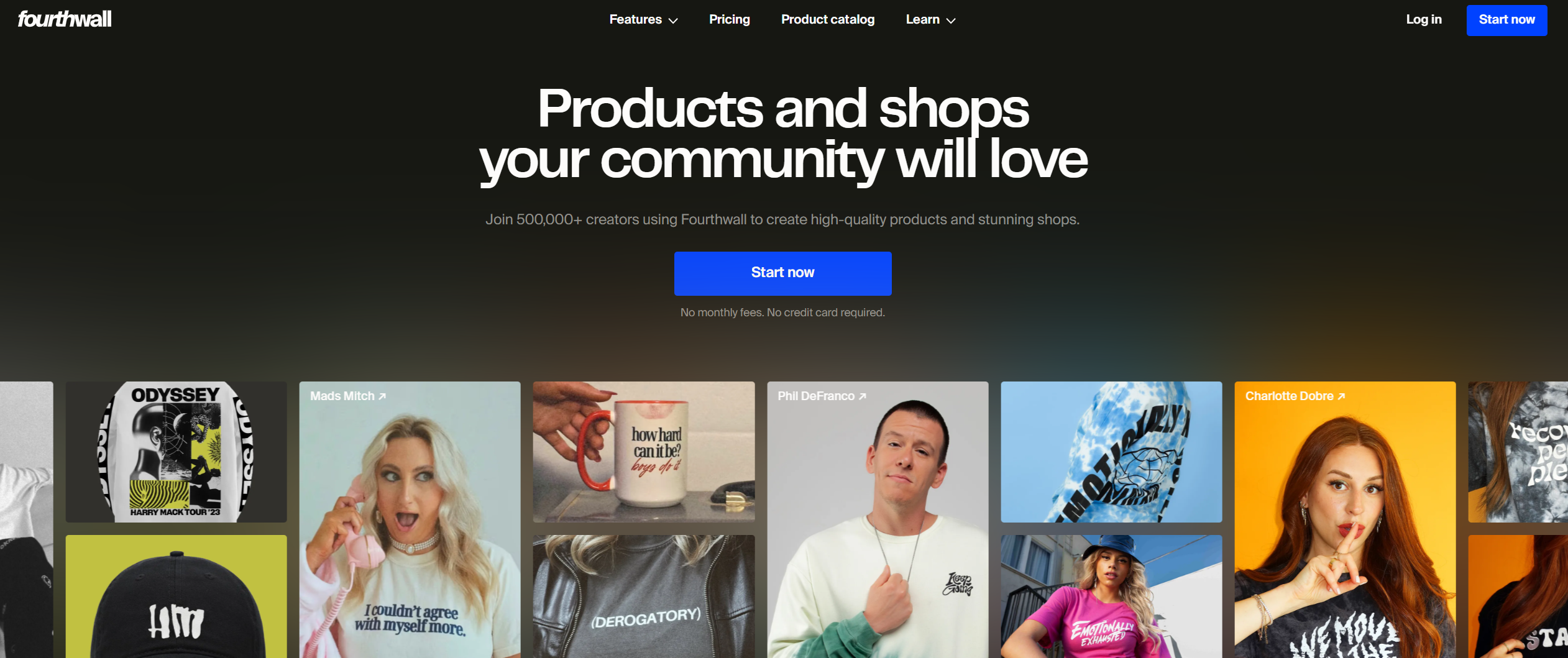
12. Fourthwall: Best All-in-One Platform for Creator Brands
- Price: Free, per-sale fee
- Fulfillment: US, EU
- Branding: Custom labels, packaging; no minimum; Premium blanks; Native storefront
- Integrations: Shopify style store, TikTok Shop, YouTube, Twitch
Fourthwall includes a design-your-own storefront plus selling POD apparel and digital products simultaneously without technical knowledge required.
Its supplied blanks possess high-quality standards equivalent to established brands but not generic POD ones. Especially useful if one already has a fan base rather than just paying for ads.
For an initial creator, this alleviates some setup work.
Pros:
- Quality sourced from real clothing makers
- No upfront charge, only cut per sale
- Inclusive taxes as well as social commerce functions
Cons:
- Too specialized for existing sellers
- Fees can add up reasonably at volume
- Fewer spots served than Printful or Gelato
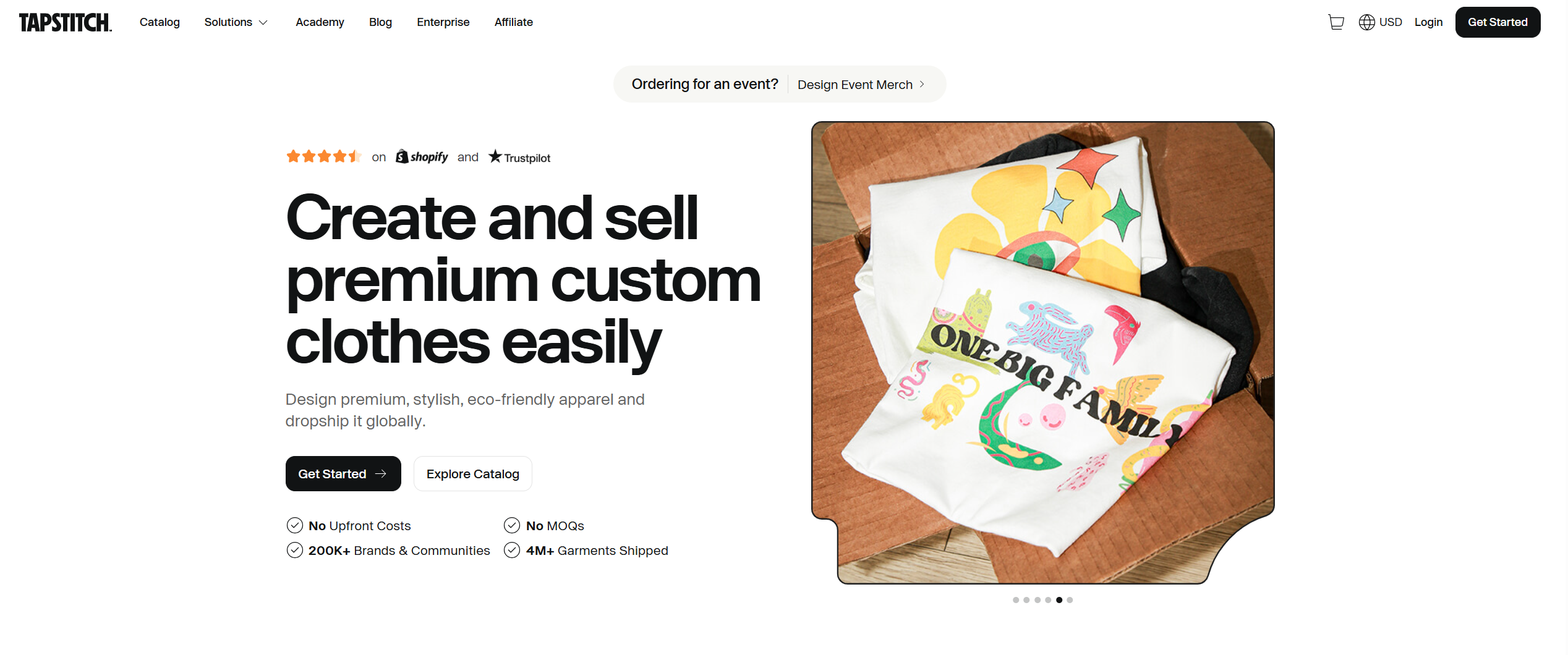
13. TapStitch: Best for Fashion-on-Demand and Heavyweight Blanks
- Price: Free (per-order pricing)
- Fulfillment: US-based
- Branding: Neck labels, hangtags; no minimum
- Product Range: Heavy clothes such as 250 GSM t-shirts and 3+380GSM hoods
- Integrations: Shopify, Etsy, TikTok Shop
TapStitch's "Fashion on Demand" approach encompasses "fashion- forward" clothing items being put on the market. Its tees default at a lofty 250 grams, alongside even heavier hoods.
Branding beyond the label consists of neck tags as well as other printings being distinctive, plus choices for oversized designs, thus giving more options.
For those concentrating on fabrics felt tactilely rather than inexpensive productions, they'll want this supplier, which stands strong on all the points listed above when it comes to quality.
Pros:
- Heaviest blanks among mainstream suppliers
- Neck tags too huge; prints possible
- No subscription required, including native TikTok support
Cons:
- Traditional machine embroidery still
- Base cost higher than budget competitors
- US locations only available
14. TPOP: Best for Sustainable, Eco-Conscious Apparel Brands
- Prices: Free. Growth plan is €30 per month; Pro plan is €70 monthly.
- Fulfillment is managed from within France.
- The packaging is recycled and plastic-free, with custom inserts and products like organic cotton T-shirts, hoodies, totes, and home goods.
- It integrates with Shopify and has support for custom domains.
TPOP focuses on sustainability by using organic cotton, water-based inks, and recyclable packaging materials for their entire supply chain. Environmental consciousness is an important part of this brand's story, as all features must match it.
Plans differ based on the number of products created: from free (100 maximum) to pro (unlimited access).
Delivery from France takes longer for US customers, which should be balanced against international audience size.

Pros:
- Great sustainability story.
- Tiered pricing transparent.
- Controlled quality by internal fulfillment.
Cons:
- Limited US fulfillment leading to delayed deliveries.
- Fewer products than global competitors.
- Paid plans needed for higher limits.
15. Redbubble / TeePublic: Best for Testing Designs with Zero Storefront
- Free to join, paid through royalties over a marketplace model
- Global fulfilment done by these platforms with no branding on purchases
- > 70 different products such as clothing plus stickers/cases/home items, etc.
- No integrations available.
- They are marketplaces.
Redbubble & TeePublic don't fit into the other suppliers' models. You upload designs, they print & ship items so you earn money from sales. There is no store or brand. They handle it all.
The royalty-centric payment arrangement varies across platforms (e.g., > $4 per premium tee). No pricing control; just like most marketplaces.
Use them to test designs' acceptance before investing in a branded store or separate models in mind accordingly.
Pros:
- No startup costs.
- Built-in audiences.
- Design-market fit testing is perfect.
Cons:
- No control of pricing, branding, or customer relationships.
- Low margins per sale due to discounts.
- Brands can't be made with white-label suppliers.
How Print on Demand Actually Works
The processes are nearly the same for almost every supplier on this list:
- When a customer discovers your store, the customer will order and pay the retail price
- The order is automatically sent to your supplier through the store integration
- You are charged the production cost, not the wholesale price
- The supplier will handle design, quality check, and packing, and also add your branding if the supplier supports it. This may take some time, but eventually it reaches the customer.
- The supplier directly sends it to your customer, and you don't have to be involved at all.
Your main incentive as a seller will be in this business model. First, you don't need to buy or keep any inventory, so there are no prepayment costs. You also only pay a production fee when a customer's product is physically made.
How to Choose the Right Supplier for Your Store
The main factors for choosing the perfect supplier are far more critical than catalog size.
- Materials and print quality of products: You may expect a consistent output with a single in-house supplier like Printful, whereas you will get more choice with a multi-provider platform like Printify at the cost of managing more variance.
- Branding and white-labeling: For instance, inserting your brand inside a shirt label, adding packaging inserts, and making neck tags all help transform a plain printed shirt into a branded garment.
- Base and true margin costs: The production charge is just one item. Your net profit will also be impacted by shipping and returns handling, as opposed to being purely determined by the retail price.
- Speed and location of fulfillment: This will come in handy if you sell to customers located in different countries.
- Shopify, Etsy, and WooCommerce support means that orders can be processed without manual work through integrations.
- Fit to a validated product: Rather than starting with a catalog, a wise business strategy would be to select a supplier according to a specific product you're sure about that a buyer will purchase, and a silhouette, a category, a print style, etc., that you want the most.
Print-on-Demand vs. Small-Batch/Private Label: Which Is Right for You?
If you go for print-on-demand, you can be assured that you will have no inventory risk, although the drawback of this mode of production would be limited product development space or margin protection. However, the downside to these smaller runs and customized manufacturing is that you need to put your money down ahead of time, but it will open up the possibility of higher profit margins at the point of sale and also a totally your-own product if the demand is established after some time.
At the heart of the POD business case is the idea of trial. First of all, run a design sample with a print-on-demand supplier to see if people's tastes change enough so that there is a demand for it. Then, once you find your product is good, you can put it in a small-batch production run once a genuine buyer signal is detected.
Bottom Line
It is hard to find the best print-on-demand business partner for suppliers. Depending on what your main goal is - experimenting with designs, putting together the complete catalog of branded products, or perhaps supplying special services like embroidery. The supplier that is the most suitable will probably be different. It is not the other way around; a supplier's strengths should be matched to a product people actually want to buy.
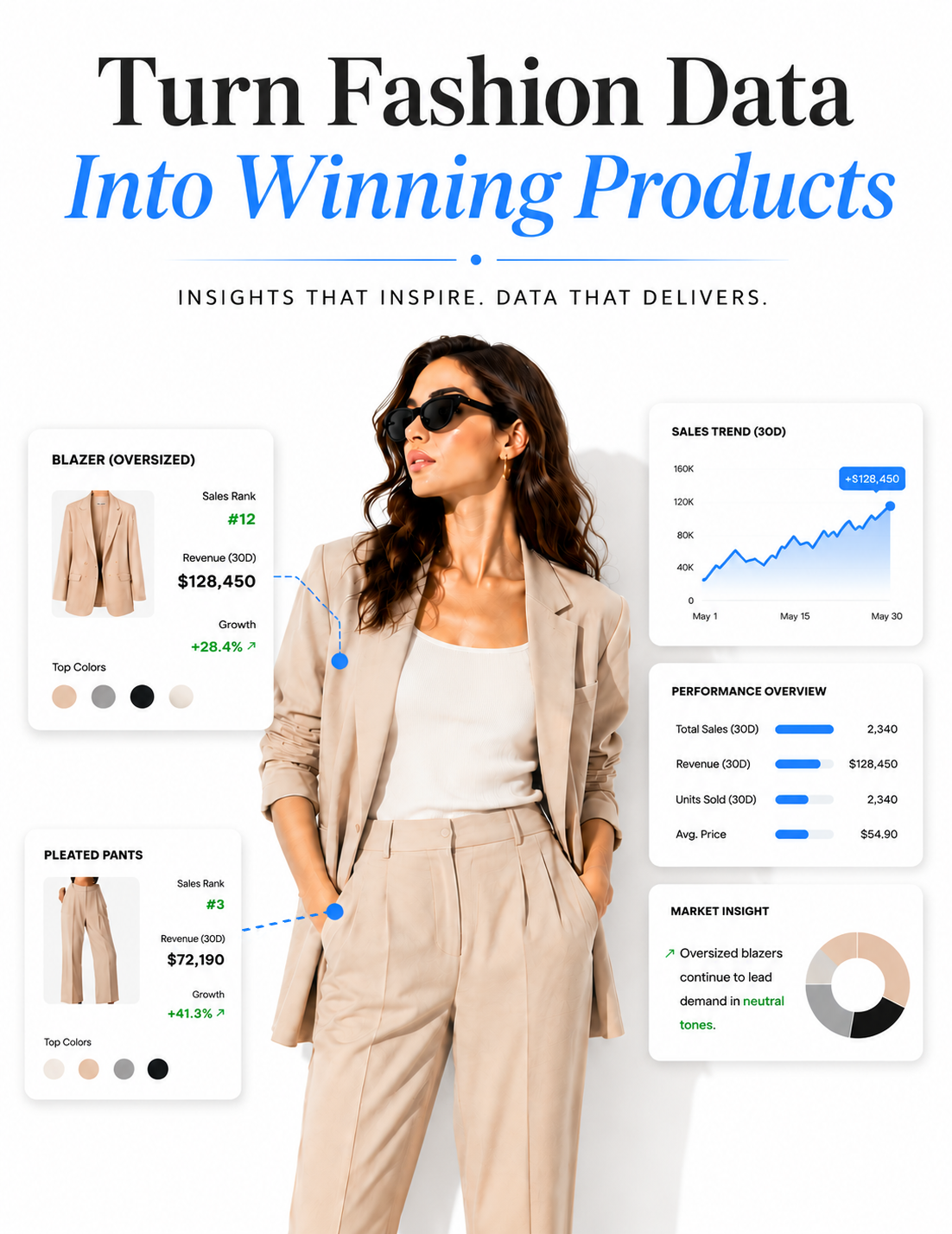
That's the thing most sellers don't do. Before agreeing with a supplier, you can run a supplier screening tool such as Garmio's Trend Finder and Market Insights, which allows you to see what types of products and how to print them are already in demand. Then the right supplier is the one who will make the specific product you need without any problem, so pick that one.
Frequently Asked Questions
Which print-on-demand supplier is best for a small apparel brand, not just novelty items?
For any upcoming apparel line, Printful and Inkedjoy are your best bets in terms of allowing extensive branding and providing quality supplies. If you're also after cost-effectiveness, consider Inkedjoy, which offers customizable branding at improved pricing.
Do I need a business license to sell print-on-demand apparel?
Most print-on-demand (POD) platforms allow you to begin without requiring a business license. In various countries or regions, there are different regulations. When revenue begins, then laws ought to be observed concerning tax compilation around your locality.
Can I add my own branding, labels, and packaging to print-on-demand products?
Yes, the majority of suppliers provide options for adding your own branding, as well as labels and packaging, including Printful, Inkedjoy, Apliiq, TapStitch, Contrado, and Fourthwall, but marketplaces such as Redbubble and TeePublic restrict branding.
How much profit margin should I expect on print-on-demand apparel?
The ordinary profit margin upon selling print-on-demand apparel ranges between 20% and 40%. Premium vendors like Contrado and Apliiq are able to fetch higher retail prices that help in keeping the marginal profit even when base pricing is higher.
Is print-on-demand a good way to test a new product idea before committing to bulk inventory?
Yes, it is certainly effective when testing any new product concept without quantitative manufacturing constraints. The strategy is to first generate actual sales through POD service providers before subsequently moving the validated design into a limited batch or a large production run for more significant earnings.
Related Reading
- How to Scale Brands with Organic Virality and Garmio's Trend Data
- How to Find Profitable Fashion Niches with Competitor Data
- The Hidden Math of Fashion Pricing: How to Price Your Products at 4x COGS (and Actually Sell Out)
- The 2026 Guide to High-Margin Fashion Dropshipping: Top Suppliers + The AI Strategy to Out-Style the Competition
Written by Garmio
Garmio provides fashion market intelligence for sellers who need clearer product, trend, influencer, and competitor signals before making inventory decisions.
Editorial note: This content supports research and decision-making. It does not guarantee sales, forecasts, fit outcomes, return reductions, or business results.
```