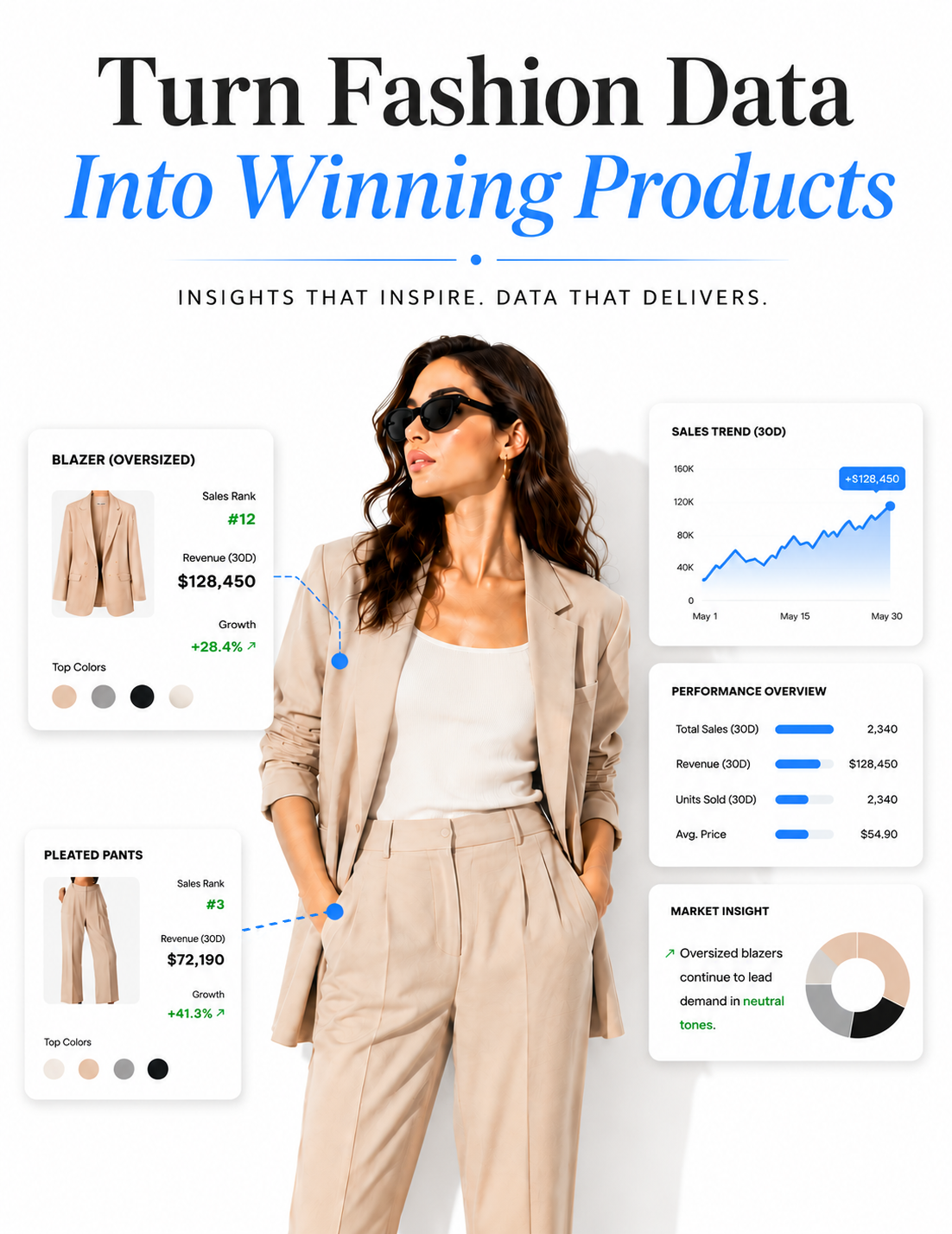

Fashion dropshipping in 2026 seems to be a battleground on the surface. Thousands of stores are drawing from the same stock listings and retailing almost exactly the same kinds of things, from dresses to shoes to accessories. The truth that really counts is that it is no longer all about finding an ideal supplier. A winning strategy would involve finding out what a new trend is getting off the ground before 10 more competitors have caught on, and being aware of your rivals already so you are not offering what they are.
In this article, we discuss the options of suppliers, some problems, and a quick, AI-based method that assists you in being ahead of your niche and not getting chased by it.
After reading this guide, you will have a good idea of where to find your products, how to determine pricing factors, and even what routine you should adopt to keep your store updated throughout the entire year.
Why most fashion dropshipping stores compete on the same 200 products
If you were to open up ten random fashion stores and start looking, you will immediately realize that they all sell the same oversized coat, the same flat sole shoes, the same mini shoulder bags in multiple shades, etc. It is because the majority of these stores access similar marketplaces and are filtered through the same list of best sellers.
A new shop owner goes to their supplier dashboard, sorts by "Trending", and adds the most popular items to the shop straight away, as one can do without any delay.
Although this is a speedy way to start up, it ends up getting nearly all the shops with identical product pages within weeks.
This sets off a situation of price competitiveness. With ten shops listing the same item, it's hardly the product quality or the presentation of product photos, but the price that would decide who gets the sale. A few tabs opened by a potential buyer, a few price comparisons later, and the product from the cheapest seller gets chosen!
A few things that can predict the direction of the success and profitability of these stores that have been caught in this loop:
- The new product list is just a repetition of the trending products every supplier already pushes to thousands of sellers
- A month-by-month rise in ad spend is needed just to compete for the same customer attention on the same items
- The margins are shrinking to the point of the store barely covering shipping and ad costs, and forgetting the profit
None of this suggests that dropshipping is over. It means that the previous method of just choosing anything on a supplier dashboard that was popular stopped working.
What high-margin dropshipping actually requires in 2026
Getting high margins simply is not about the supplier providing the lowest prices on top-quality goods. It all relies on the three elements being in harmony.
Product selection that isn't copied from a bestseller list
A product that is unique and not yet on your competitors' sites gives you higher profit mainly because you are the only one in town to sell it to the customer; thus, they can't price-compare it across 5 other shops. It's not about selecting weird and rare items that no one wants, but it does mean selecting a trend which you have spotted early before others get caught with it. It's about picking a trend that's gaining momentum but hasn't become mainstream yet at the time of your selection.
Speed on rising trends
When it comes to fashion, nothing is fixed. It's like a flowing stream, constantly changing. You won't be able to keep the same trend for long, as it quickly becomes outdated. The stores that capture the essence of that movement at the very onset sell at full price to customers who badly need it. While stores that are late to realize have to resort to discounting the items for which there is practically no demand, having previously spent considerable amounts on advertising and marketing of that same product.
Pricing built on real costs
Margin is not the difference between the amount you pay the supplier and the price you sell to the customer. You may not be able to see these additional expenses in your invoice or profit and loss statement, but they will impact the final bottom line. Here is an illustration.
- Cost of goods from supplier
- Shipping, packaging, and handling charges
- Returns rate based on the type of product
- Charge of your transaction (credit/debit card, etc.)
- Digital marketing and/or in-store advertising expenses per individual customer
The cost of the product, alone, without the consideration of return and marketing, usually gives you a false impression of a profit of a product; however, a loss is usually the end result. Hence, a pricing strategy based on your total cost of goods plus a multiple, e.g., a 4 times COGS system or what is known as a COGS-based pricing method, is much better than the guessing game of simple markup.
Supplier options in 2026: what's actually out there
Finding a great supplier can determine margin levels, how many items get returned, and the speed at which orders get delivered to customers. When you pick the wrong supplier, the profit will definitely take a hit, and chasing trends can hardly help. Here is a plain look at the three major seller choices that sellers can take in 2026.

Vetted marketplace suppliers
You get many product options, fast setup, and a single place to manage inventory if you use vetted marketplace suppliers. Suppliers store the goods, you list the products, and you pay only when customers buy them. Suppliers are able to sell you goods at lower prices because their business involves working at scale.
You will definitely expose yourself to thousands of competitors in the same marketplace if you pick these suppliers. So again, you become stuck in the same product pool covered in this guide that is already very crowded. Marketplace suppliers may be the best option for a seller who needs to test the waters quickly with a fashion trend prior to taking a plunge with a bigger order at another place, for instance.
Private label and small batch suppliers
The most unique thing about working with suppliers of private label or small batch is that they allow you to change the design of a product and put a brand label on it. Some of them also do production on a small scale rather than bulk production.
It can take more time, and you may need to order a larger quantity than you do when listing a product on a marketplace. Nevertheless, your goods will not be in the same listing with other products at various stores, and you will be in a better position to manage the quality and the fit of your goods. That makes this route ideal for a seller who already knows which product category does best and now wants to be in full control of their goods rather than just renting them from a shared catalog.
Hybrid models
Some entrepreneurs take advantage of both options at the same time. Using marketplace items for quick trend testing is ideal due to the speed of getting your products ready for sale and the low price at stake if something does not turn out as expected, so marketplace items cover your trend testing needs. When a product proves to be a solid hit and starts bringing in repeat buyers, it is then that private label items can be used to cover the best-selling items.
This kind of division between the supplier types keeps the seller's total risk fairly low while simultaneously developing a set of genuine products that he will own eventually, rather than the buyer committing to one supplier type in the beginning only to regret later.
What to check before you commit to any supplier
Listed is the set of things that you need to do to a prospective supplier before making him part of your store:
- Order a sample by yourself and verify the quality of the stitching, the feeling of the fabric (i.e., how thick or thin it is), and the accuracy of the sizes against the ones that are listed on the item
- The supplier should be able to tell you what the usual lead time is for fulfilling orders and shipping, and that written statement should not merely be a general estimate of how long it is based on the information on the supplier's profile page.
- Familiarize yourself with how suppliers handle refunds and damaged products since the latter is a problem mostly in product categories with high return rates, which quietly eats up the margins even when the sale price looks strong.
- Make sure that there is a stock reserve. Losing a popular item just because the supplier ran out of it in the middle of your campaign would cost you sales as well as the ad spend that you already allocated.
A supplier who may be expensive in prices but who also guarantees that shipping is not a problem will most likely give you a better experience compared with going for the cheapest supplier but having to get lots of refunds. It is not just lost sales that refunds bring, because one also loses the ad spend that was used in getting the sale.
The AI strategy: trend data and competitor data instead of copying bestseller lists
Dropshipping shops can use current trend data to know what customers want. They can watch trends that emerge before they are common in stores. They can see where the colors and styles are that are becoming popular in the world.

Catch trends before they're everywhere.
A tool keeps track of popular categories, hues, and styles among other stores. It will help one to discover demand before it is evident everywhere. This is particularly crucial around fashion shows. The colors and styles that are presented at those shows often attract a lot of interest online before they are available in shops. By identifying a color trend shortly after a fashion show, one has an upper hand against stores selling things from the previous season.
Check what your competitors already sell.
A tool shows which items different stores sell and their prices. One should beware of items having too many others since the profit margin is already reduced. Look for a related product that appeals to the same trend but does not compete directly.
Keeping an eye on competitors' prices is critical too. In case any competitor drops its price, one should take notice so that their sales do not decline without their being aware.
Tie your data to a seasonal plan.
Trends change with seasons; however, fashion usually follows a certain calendar. Combining trend data with a template of seasonal catalog ensures stores offer items according to what shoppers actually require each quarter. For example, selling summer colors in October. A live trend page assists one in seeing how this data works with actual catalogs over time.
A monthly operating rhythm for a lean dropshipping store
Running a small-scale store does not necessitate working tirelessly or looking through data on a daily basis. Having an uncomplicated, uniform rhythm keeps catalogs fresh without guessing.
Establish fixed days for each task so that they become routine instead of waiting for slow sales to remind oneself. Running a store in an autonomous manner reduces a lot of time spent trying to address slow weeks.
| Task | Frequency | Purpose |
|---|---|---|
| Trend check | Weekly | Spot rising colors and categories early |
| Competitor audit | Monthly | Avoid listing saturated products |
| Catalog refresh | Seasonal | Match stock to the fashion calendar |
| Pricing review | Monthly | Confirm margin still covers real costs |
Stick to this, and your store stays current without you sifting through data every single day. Most of the value comes from consistency, not from spending more hours on it.
Common pitfalls to avoid
Retailers tend to make some recurring errors that lead them to fail in managing margins.
- Allowing yourself to board the trend's wagon after twenty stores start marketing it. This will obviously lead you to contend merely on cost.
- Overlooking sections characterized by high return rates whose refunds and reverse shipping costs quietly reduce profit margins despite the product's strong sales figures.
- Bypassing the sample order step, thus believing the supplier's photos only. This causes size and quality complaints upon launching.
- Updating the entire catalogue only once per annum rather than checking weekly and monthly, hence resulting in selling past season choices even when they are no longer up-to-date.
Before funding a new listing or refreshing the entire catalogue, remember to check these.
FAQ
Is fashion dropshipping still profitable in 2026?
Yes. However, the margins for generic products that are extensively listed have shrunk; thus, profit derives from picking the right product at the right time rather than merely locating a cheap supplier.
How do I find trending fashion products before my competitors list them?
Investigate category, color, as well as silhouette demand directly, but avoid observing what competing stores sell; as once--- a product appears fashionable through many shops, the early margin disappears already.
What margin should I target on dropshipped fashion products?
There is no universal figure applicable across all stores; hence, an ideal start point entails pricing covering full landed cost plus return, fulfillment, and marketing expenses instead of merely doubling the supplier's given price tag while using a multiple of total product costs.
How do I avoid listing the same products as every other dropshipping store?
Scrutinize dealers' coverage first before being aware; whenever a trend has been saturated within your niche, opt for an adjacent, less covered variation rather than collegially competing head-on for exactly the same page concerning goods.
How often should I refresh my dropshipping catalog based on trends?
It fits most stores whereby weekly observation to identify gaining categories, colors, plus monthly assessment about competitor saturation ensures timely catalogues without demanding daily attention, especially total seasonal renovation.
Do I need a large supplier network to run a high-margin dropshipping store?
Not necessarily needed. However, smaller, reliable vetted suppliers with consistent fulfillment outshined larges inconsistency. Late cancelled orders lead to refund chargebacks higher than paying a slight extra price toward timely shipping from the supplier.
What's the biggest mistake new fashion dropshippers make?
Imitating suppliers' trends list without ascertaining competitors already saturating it, thereby putting brand new stores on a price war day one. Before a store's brand recognition, engaging competition goes beyond price only.
Related Reading
- How to Scale Brands with Organic Virality and Garmio's Trend Data
- How to Find Profitable Fashion Niches with Competitor Data
- Ditch the Blanks: How to Use AI-Assisted Style Redesign to Launch Custom "Cut & Sew" Silhouettes on a Budget
- The Hidden Math of Fashion Pricing: How to Price Your Products at 4x COGS (and Actually Sell Out)
- How to Source High-Quality Micro-Collections (and Stop Wasting Money on Low-Margin Print-on-Demand)
Written by Garmio
Garmio provides fashion market intelligence for sellers who need clearer product, trend, influencer, and competitor signals before making inventory decisions.
Editorial note: This content supports research and decision-making. It does not guarantee sales, forecasts, fit outcomes, return reductions, or business results.