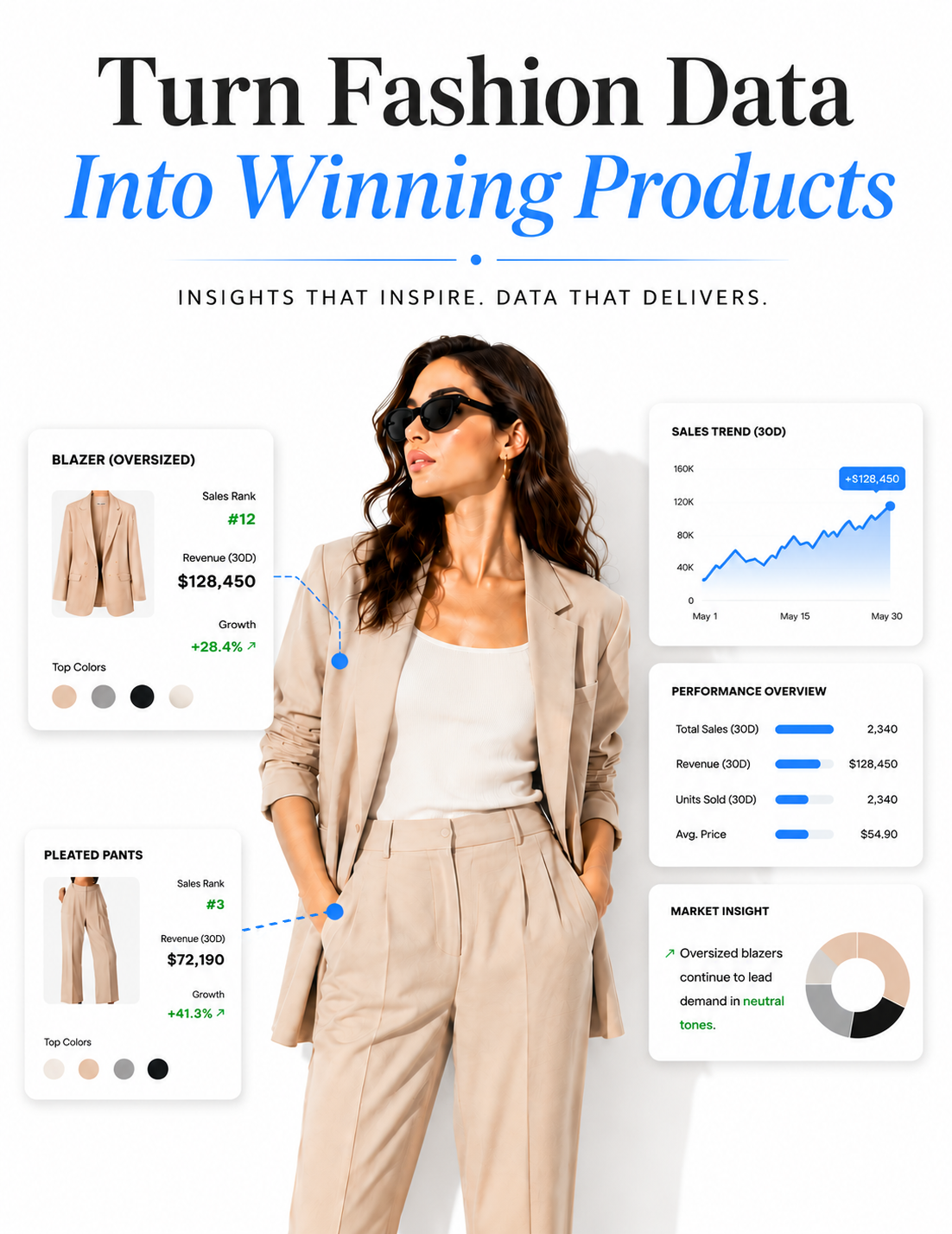

The lack of competition does not mean you can make high profitability, either! You might rank first for a keyword with nearly no one bidding on it yet still end up with no sales since the people searching it can't even afford it or don't really have any problem, but just out of curiosity. A profitable fashion niche requires four things simultaneously: real demand, a clear reason why your product is different, workable economics, and a supply chain your team can handle.
This guide will show you how to utilize competitor data to find a niche instead of relying solely on a keyword tool.
Start with a specific customer and job.
Steer clear of overly general labels. A phrase like "women's activewear" does not provide any real information. A more narrowed-down niche description comprises: customer, situation or problem, the product, and price logic.
Say, for example, a customer is busy young parents looking for nursing-friendly tops to make those pre-dawn walks. They are ready to pay a reasonable price but at the same time not so cheap that they will not buy multiple pieces of them!

This brief paragraph gives you a customer to do your market research, a keyword to run your search engine test, and a price band to benchmark against your competitors. Rather than using a general demographic guess to figure out potential consumer desires, create your niche statement around your observed needs.
Mine competitor search data for gaps
If you have a good niche statement now, competitor research is going to tell you whether a niche gap actually exists or a market for it is already occupied.
Map three types of competitors.
- First-level competitors who sell the exact same kind of goods to the very same type of customers are the easiest to identify.
- Borderline competitors who are selling a nearly identical product to customers of a similar target group.
- Complementary competitors offering another sort of product with an entirely different set of features to the same problem.
Study what they show you.
Don't just stop at looking around one's home page, but analyze each competitor for these features:
- The size of the selection, which basically is the number of variants in the niche that competitor carries;
- How often a competitor unveils a new design, which can be an indicator of that category being very actively being worked upon;
- Price tiers, and where there are noticeable holes in the budget and premium range; and
- The types and frequency of promotions, since a product constantly being on a discount might be signaling an underselling demand in the market for that product;
- Language used to describe the products by the seller, i.e., the titles and description words;
- The recurring customer complaints on reviews that may just reveal a hidden opportunity not to be missed;
The kind of event or the situation that people repeatedly write about in their reviews but that nobody has made an actual product to cover the need might be the strongest indication of a gap yet to be filled.
Score demand without chasing vanity volume
Just by looking at the surface, a niche could seem extremely competitive and yet, after digging in, all of those clicks could simply be attributed to one type of search behavior which is not the main driver.
Use the total volume figure combined with a lot of different indicators, for instance: the direction of searching over time, product-related social media momentum, the number and quality of the content creators talking about it, how far the product has already permeated the market, and also the real search terms the customers are typing when they want to find something matching the product.
All of these together are important so that the peak of your trend that comes about after a very popular video looks just the same on a graph as gradual growth, but in reality, they can go two different directions once the trend dies out.
Tell the three demand types apart.
Not every number that is increasing is pointing at the same thing:
- Evergreen demand is the one that keeps more or less stable all around the year. Like a simple layering garment would be a product that people would be able to wear all through the seasons.
- Seasonal demand refers to demand which follows up in accordance with some sort of calendar; this is the case with swimwear or some other kind of beachwear or even sets of clothes for special events like holidays.
- Microtrend demand can skyrocket very quickly and then also drop dramatically within very short periods, and most of the time it is related to a single video or a moment of influence from celebrities on social media.
You are taking a bigger gamble if you are launching a product only on microtrend demand, as both your production and your marketing plan have to keep your customers interested, and at the same time you have your goods in stock.
Run the niche economics test.
A niche is usually not worth entering in case of a high demand alone. The numbers behind sales determine it.
Check these items off your list before you invest any resources into a new niche:
- Cost, including landed cost, that is shipping and duties, not only the factory price per unit
- Gross margin after landed cost and discounts
- Return risk: categories with a heavy fit have higher return rates
- Cost of acquisition tolerance: the amount you are able to spend on bringing a customer and still getting a profit
- Repeat purchase or a potential of developing an attachment: a niche with strong add-on sales can absorb the thin first-sale margin.
Prepare three sets of forecasts: a low one, a neutral middle, and a best-case scenario.
| Scenario | Sell-Through Assumption | What It Tells You |
|---|---|---|
| Low case | Slow, below break-even sales | Whether losses stay manageable if the niche underperforms |
| Middle case | Steady, near break-even sales | Whether the niche covers cost and modest profit |
| Strong case | Fast sell-through, reorder needed | Whether you can restock in time to capture demand |
Validate with a small market test
Figures on a spreadsheet only speak to a limited extent. A small live test tells you the rest.
Choose one of the methods that validates according to a budgetary limit and time frame:
- An email sign-up landing page is a great way to determine the level of interest before anything is done
- Set up a waitlist linked to a particular launch date
- Run a brief test with a content campaign across social channels to measure how many people engage and comment
- Open a preorder period with production of just a few units
- Launch sample production by orders with a low minimum quantity through only one marketing channel
Before looking at the results, decide on the pass and fail numbers. If you determine only after seeing the data what constitutes success, you may just interpret any number you got as a win.
How Garmio speeds up niche research
With its Garmio feature, you combine multiple research stages into a single workflow, which saves you the time of jumping back and forth between browser tabs and different spreadsheets.

If you use the product trend finder, you not only find products in your niche with good demand, but you can also identify the fastest-growing product categories. This gives you a chance to catch on to those categories before your competitors, who are probably not even aware of them yet.
Track Instagram influencers who bring you maximum impact and find, with the help of influencer trend tracking, the exact products that become a part of a viral trend because of influencers. This way you see the products that actually drive conversations, not just which Instagram accounts have the most followers.
Before the market is flooded with similar products, discover high-margin, low-competition opportunities through the use of market insights.
Competitor monitoring allows you to see new arrivals, competitor pricing strategies, inventory turns, and bestselling designs as these happen by means of the competitor monitor feature of Garmio.
Create your niche scorecard and combine competitor research with product development ideas all in a single location within Garmio.
Conclusion
Get to be the solution to the customer's problem before you get stuck on keywords. A niche is only a good thing if demand, differentiation, margin, and operational limits coincide. Competitor data provides you with the evidence to verify these points before you commit to ordering stock or launching an advertising campaign. Define a niche statement, pinpoint gaps, evaluate demand sincerely, run the financial calculations, and try a small-scale test before launching at scale.
Companies that regularly look at the niche market situation and use these insights as a guide are usually the first to find the next gap when their competitors are just getting started. Markets change quite constantly; customers' expectations and review language change, and there is a chance that the saturated niche that you saw last quarter has opened again once one of a competitor"s exits or a trend slows down.
Make a Garmio niche scorecard today to kick off your fashion niche search. Get to garmio.ai to use competitor data in your search for a profitable fashion niche.
FAQ
What are profitable fashion niches?
The most profitable fashion niches are focused markets where customer needs and demands, product differentiation, pricing strategy, and cost structure are aligned for a long-term profitable contribution margin. Just because a niche is in trend doesn't mean it qualifies.
How do I find a low-competition clothing niche?
Begin with one problem of the customer, not a wide category. Investigate the search language, competitor stock, reviews, and social signals of products related to that problem, and you can then test anything in a much more informed way.
Does low keyword difficulty mean a niche is profitable?
No. Low keyword difficulty score mainly refers to an SEO opportunity; however, it doesn't mean that the niche is profitable unless it meets a strong demand, a high margin, few returns, low fulfillment, and a reasonable customer acquisition cost.
What competitor data should fashion brands track?
Assortment depth, price bands, new arrivals, promo frequency, variant patterns, merchandising language, customer reviews, and restocking or sell-out visibility should all be tracked.
How many competitors should I analyze?
There is no universal number that suits all niches. Instead, focus on a relatively small number of your very relevant direct, adjacent, and substitute competitors, which you can use to draw a more accurate picture than if you were to list a whole bunch of loosely connected brands.
How does Garmio support niche research?
Garmio provides integrated trend data, visual analysis, competitor activity, review analysis, and influencer tracking within a single workflow, thereby enabling teams to move from initial concepts to a tested product plan quickly.
Can competitor research tell me a brand's sales?
Very often not, not even from a company's public data. Consider available product listings, pricing changes, and merchandising styles as indications of what's successful, not actual sales figures.
Related Reading
- Micro-Collections Made Easy: How Garmio Helps You Design and Source Fast with Low MOQ Suppliers
- How to Reduce Bracketing and Apparel Returns with Better Product Data
- Stuck at a 1.5% Conversion Rate? 5 Fast Ways to Turn "Window Shoppers" into Buyers with Visual Style
- How to Spot Next Week's Viral Apparel Trends Before Your Competitors
- Beyond Google Trends: A Boutique Forecasting Workflow for Fashion Sellers
Written by Garmio
Garmio provides fashion market intelligence for sellers who need clearer product, trend, influencer, and competitor signals before making inventory decisions.
Editorial note: This content supports product and market research. Trend signals, forecasts, and product-page improvements do not guarantee sales, fit outcomes, lower return.