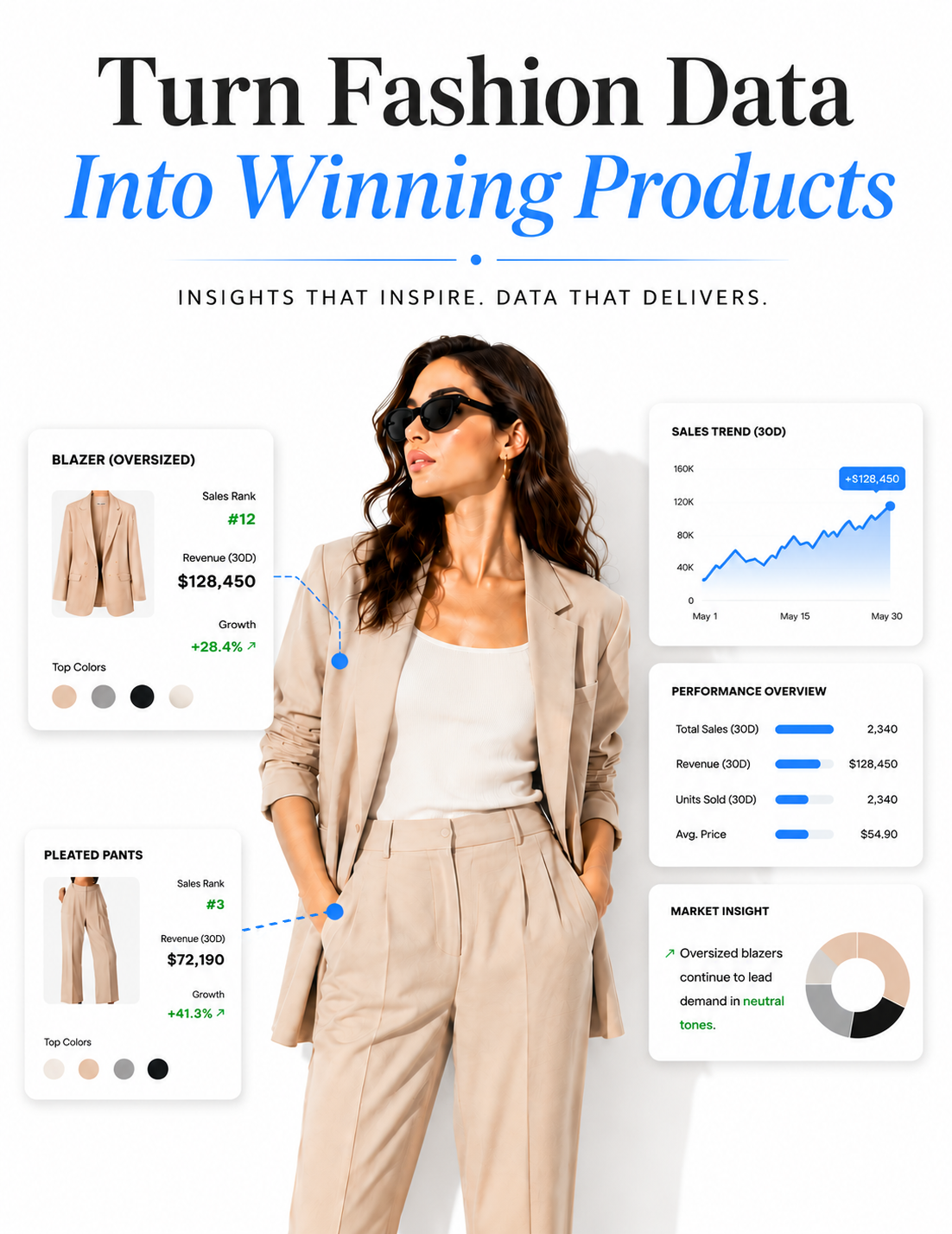

Google Trends can show when interest in a fashion term is rising, but it cannot tell a boutique which silhouette, color, price, or customer segment will convert. A stronger forecasting workflow combines search language with creator momentum, product evidence, competitor activity, and controlled buying rules so each order is based on converging signals rather than one chart.
Why Google Trends Is a Starting Signal, Not a Buying Decision
Key Takeaways
- Use Google Trends to identify rising language, geography, and seasonality, not unit demand.
- Validate search interest with creator, product, competitor, and market evidence.
- Order a controlled test quantity and define reorder and stop-loss conditions before stock arrives.
A boutique buyer discovers a certain term trending on Google Trends. The curve keeps getting higher from week to week, so the buyer places large orders without delay. Two months pass, and the buyer's still none the wiser about which color did particularly well; which size was the first one to go off the shelves; which customer actually laid hands on that piece. The gap fashion forecasting needs to seal is just this.
One of the best ways to get on the right track is via Google Trends. But, by itself, it doesn’t indicate which specific silhouette, pricing, tone, or audience are likely factors in the term getting hot enough to be turned into real sales. Combine it with a few additional indicators and the number of uncertainties will diminish rapidly.
What Google Trends Can and Cannot Tell a Fashion Seller
The tool does not show you the quantity of orders or units sold but rather a normalized index between zero and one hundred. Google Trends gives you an idea of the most popular terms at different times but cannot be relied upon as a demand indicator.
Some of the features you will get from reading the chart are as follows:
- General interest trend showing either increase, decline, or steadiness of interest level
- Location of searches: so that only the regions where searches for a term are highest can be identified
- Time: a look is likely to be searched at a peak time in the same way every year
- Trending terms: the search terms paired with a particular trend
Some of what the tool does not provide on its own are:
- An accurate prediction of which style, fabric, or fit will go on to sell well within that particular trend
- How changes in competitors' assortment have already occurred in the specific area you are a player in
- Identification of the number of different creators actually displaying a look vs. a viral video only
- Complaints made by the buyers on reviews about fabric, quality, or price
- Whether or not the trend can actually work with your profit margin
A rising line is a trigger for deeper inquiry, not a command to get your orders straight. There is the possibility that two fashion products may show exactly the same level of popularity on Google Trends, yet when they end up being available online (in the store window of a virtual shopping mall), their sales rates differ significantly.

One product may be an item of a trendy brand which enjoys a loyal customer base that buys the brand year after year. Another one is going to be a short-run product of a certain color linked solely through a viral clip.
The Boutique Forecasting Stack
Diving deep into different signal groups is necessary to convert only one search spike to an actual buying move. Each one tackles a question Google Trends cannot.
Search Language
A buyer will probably refer to something using his/her own words. These words may not, however, conform to terms used in the fashion industry. A buyer will go around searching "cottagecore dress" at a time when a trade report will be calling the trend a "prairie silhouette." Keep track of the very phrases people type in, including the spelling deviations.
You will know which language to use on your product page and ads by observing how people search the internet and by watching trends.
Social and Influencer Momentum
Google Trends are mostly just a tail of the initial trends that started weeks ago with video clips or image sharing.
Do not rely on the number of 'likes' or how viral a post gets, but check out how many creators actually wear the same outfit without being influenced by each other. A single viral clip could lead to a trend, but it could just be luck. If, on the other hand, ten different people wearing the same look are spotted in various cities, it probably means the trend has become a real phenomenon.
Also check the comments. Shoppers tend to look up their own reviews for sizing or costing before they finally buy.
Product and Competitor Evidence
Keep in mind how your category mates are developing. New arrivals, restocked colors, fresh sizes and price adjustments show the competitors already decided what to place and where the risk was for them. If a print that was introduced to the market is dropped by three sellers, the print itself is sending you a signal, which is totally independent from the chart or anything else.
Customer Evidence
Buying a piece or returning it depends on the reasons the customer gives for doing so; the latter might not be written down as clearly as the former. Reviews on the net and comments on social media pages are the most useful pieces of information since these tell, in the first place, what the customer bought for (occasion) and, in the second place, what fit issues he has with the product, etc.
By aligning this quartet of information sources to your existing knowledge of Google Trends, you can transform one signal into a choice with sufficient backing.
A Weekly Forecast to Buy Workflow
Instead of guessing once per season, you can regularly make forecasting an easy weekly routine.
- Before you open any charts, define the customer segment, category, margin floor, and test budget.
- Based on the type of customer, find and select 2 or 3 terms that are gaining popularity.
- Come up with visual proof by doing a side-by-side comparison with other similar products that are available for purchase on the market.
- Identify competitors' assortment, pricing, and availability of stock
- Look into the customer's language in reviews and comments for clues regarding the fit and the occasion.
- Based on the level of signal consensus, evaluate and set confidence as low, medium, or high.
- Order just a bit more than your normal test quantity, not an entire season lot.
- Fix both reorder and stop-loss conditions in advance, before the stock actually reaches the shelves.
This cycle of eight consecutive steps continues to deliver a quick, repeatable process week after week.
How Garmio Makes the Forecasting Workflow Faster
Trend research, visual, and competitor tracking are integrated features in Garmio that you can use in the same place so that no time is spent on multiple browser tabs and spreadsheets.
You can get detailed market data on the color, pattern, and style associated with an up-and-coming term through Garmio rather than relying only on numbers in a graph.
Trend finding and influencer signals are embedded features within each research step so that they can be verified in one single place.
The search for images and competitor monitoring are ways to cross-check and verify a trend through actual examples or products rather than relying solely on data.
The main focus is to remain very straightforward. Get a signal to your production team and have a test order done in the minimal time possible. The main focus is to remain very straightforward.
Generally, many boutique teams spend a lot of time retrieving the necessary data from search engine tools, then from different kinds of social media apps, then on competitor websites, and finally on review sites. Garmio consolidates all these four aspects within a single interface; therefore, the weekly analysis can be carried out in minutes as opposed to an entire day.
Garmio combines fashion-focused product intelligence, influencer intelligence, competitor monitoring, and market analytics. Instead of relying on one normalized search curve, boutique teams can compare selling activity across Amazon and Shopify stores with Instagram creator signals and visual attributes such as style, color, fabric, pattern, and price.
The goal is a faster research-to-test cycle. Use Garmio to identify and cross-check market signals, then apply your own customer profile, margin floor, supplier constraints, test budget, reorder trigger, and stop-loss rule before committing inventory.
Three Worked Scenarios
These scenarios are hypothetical. They walk through the pattern, not a guarantee of what your store will see.
| Trend Type | Signal | Validation | Small Test | Decision |
|---|---|---|---|---|
| Color led (butter yellow) | Search interest up sharply over six weeks | Several creators wearing the shade, two or three competitors restock it | Small run in one core silhouette | Reorder once sell-through passes a set threshold |
| Silhouette led (wide leg denim) | Steady rise across a full season, strongest in one region | Reviews on similar cuts flag a fit issue at the waist | Small batch with an adjusted size chart | Hold price, fix sizing copy, watch return rate |
| Aesthetic-led (quiet layering) | Flat search score but steady repeat searches over months | Creator posts stay consistent, no single spike | Small capsule at a higher price point | Treat as slow, steady demand, skip a rushed reorder |
Notice the shared pattern across each row. Signal alone never places the order. Validation and a small test come first, every time.
Replace One Dashboard With a Decision System
Even the best chart or graph does not carry all information for a purchase decision. The best way to see and understand all these data points is to look at search terms, creator activity, competitor moves, and user reviews as a single system every week. Ordering only small test samples and having clear reorder rules will give you a chance to figure out how profitable a trend is for your store without having to lose all the products on your shelves.
To make your weekly trend analysis more productive, scan potential hot products in Garmio and get a well-stocked, sold-out collection instead of a stockpile of unsold articles. Start your Garmio trend scan today and build your next collection based not only on graphs but on other strong signals that have been proven to be reliable through testing in different markets.
Frequently Asked Questions
Is Google Trends useful for fashion forecasting?
Yes. Google Trends helps a great deal in the relative measurement of interests and the geographical as well as the seasonal aspect of the trend. Combine it with social media, product, competitor, and customer data before you finalize an order.
What is the best fashion forecasting method for a boutique?
The best approach is a minimal, weekly check. Start with knowing your customer and margin level, evaluate the trend with multiple data points, and then validate it via a small test purchase.
How often should a boutique review trend data?
Fast-moving items require weekly trend reviews, while a full assortment and seasonal purchases need monthly or quarterly trend assessments along with the weekly trend checks.
Can AI predict fashion trends accurately?
AI technologies can find trends in a set of data and support forecasting decision making. However, they are dependent on the quality of data, product category, market, and how long you're going to make your forecast for you to get good accuracy.
What signals should I combine with Google Trends?
Look at the number of creators doing such activities, repetitive colors and cuts being worn, the activity of competitor products, the language used in product reviews, change in retail strategy such as pricing change, and past sales data.
How does Garmio help small fashion retailers?
Browse, trend discovery, competitor research, sentiment analysis in product reviews, and influencer signals, plus other AI-powered style work are the features made available by Garmio in a single task-oriented operation.
How do I avoid overbuying a trend?
Try ordering small quantities of a product in case a trend over-purchases occur. Order only if they are below your margin floor. You can create reorder and stop-loss rules to be able to do it beforehand.
Related Reading
- How to Spot Next Week’s Viral Apparel Trends Before Your Competitors
- How to Reduce Bracketing and Apparel Returns with Better Product Data
- How Fashion Brands Can Reduce Fit-Related Returns
- How to Find Profitable Fashion Niches with Competitor Data
- Micro-Collections Made Easy: How Garmio Helps You Design and Source Fast with Low MOQ Suppliers
Written by Garmio
Garmio provides fashion market intelligence for sellers who need clearer product, trend, influencer, and competitor signals before making inventory decisions.
Editorial note: This content supports product and market research. Trend signals, forecasts, and product-page improvements do not guarantee sales, fit outcomes, lower return