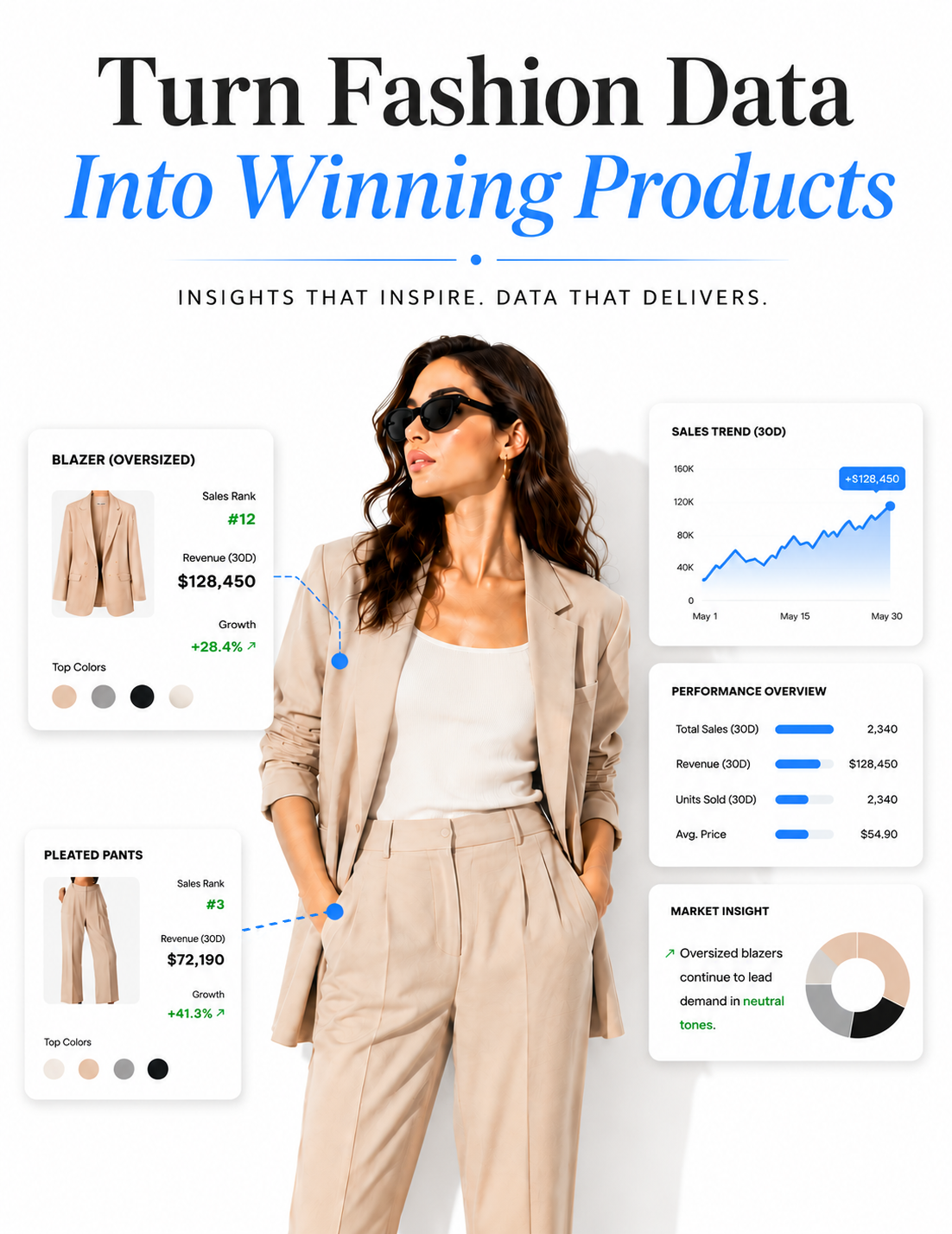

Viral apparel trends rarely appear without warning. Creator momentum, repeated visual details, competitor assortment changes, and product-market activity often move before broad search demand peaks. Small fashion teams can use these signals together to identify promising patterns, reject isolated hype, and run a limited inventory test before making a larger commitment.
Why Early Trend Detection Requires Signal Convergence
Key Takeaways
- Treat a single viral post as a clue, not proof of demand.
- Look for convergence across creator activity, repeated visual attributes, competitor moves, and market data.
- Test small, set reorder and stop-loss rules early, and adapt the trend to your customer.
Monday might find a style suddenly getting popular, and Thursday the fashion houses might have run out of stock. This rapid pace of change presents a major challenge for small clothing stores that are struggling to keep up. You may have seen the style being talked about widely across social media platforms.

The good thing is, you need not gamble by either going the guessing route or by spending big on an enterprise platform that would only benefit global brands. Viral fashion trends give off various signs beforehand, such as social media activity, product placements, competitor activities, and customer feedback. A sound fashion trend predicting approach combines all these indicators instead of just concentrating on a single clue. This article will walk you through how to identify a genuine trend early on, validate it quickly, and ultimately translate it into sales.
Why "next week" needs signal convergence, not a crystal ball
Relying on or expecting one factor or a number to determine that a fashion trend is genuine is not a good idea. In fact, the best way to tell that this is a trend is to follow what happens in several different ways.
- Leading signals" are the indicators that appear first. For instance, a designer may first pick up a trend, then a certain type or silhouette of garment keeps coming up, or a combination of colors and a print are seen again and again across feeds.
- The arrival of "confirming signals" means that the product has been recognized for its popularity in several other shops; this is reflected in the growing numbers of reviews, availability of different colors and sizes from one brand, and so the brand will continue producing this style.
- When "lagging signals" arrive, there is an increase in search volume for the trend, and more media coverage, etc. These are signs that the trend is losing its heat.
One good way for you to operate: you only take action when three separate signals are pointing to the same outcome. A single viral post is simply noise. Three signals pointing in a direction are the start of a pattern. You may take action upon seeing the pattern.
An apparel trend-spotting framework made up of four signals
These clues ask different things but altogether form part of the answer. Reading them in combination will offer you a significantly better view than could have been given by just one of them.
Social velocity
Don't consider the popularity of a trend just based on one post. The trend has a lot of momentum when it is caught by multiple unrelated creators in a short time period in quite different regions or styles. Wearing something by just one influencer is no different than one data point of evidence. However, if five different creators make the same type of look by styling a similar kind of silhouette in one week, that would be a very meaningful signal.

You can monitor:
- An increasing number of references to the fashion trend on one platform or more,
- The number of new content or posts of the same kind is increasing without being a mere replication of the same content of the original post,
- Comments like "where have you bought this?" which go deeper than just "like" or "thumb up
Visual repetition
Most often, fashion trends will take off with a garment's look before its name. To recognize the trend, one should keep track of recurring silhouettes, the finishing touches on a piece, the fabric, colors, or the way several garments are being worn together. Suppose that a cropped jacket shape or a tone of green that is very close to a shade of leaf green keeps repeating itself across different brands and creators; the repetition would be a clue that the trend is gaining popularity that can't be seen from a single post.
Using image-based search technology will save you a lot of time. You will be able to bring all the looks similar visually to an outfit you are working on together and compare cut, fabric, and finish side by side.
Competitor validation
Your competitor shop might not do it intentionally, but their sales records can serve as a sort of free research for you if you are able to read into them. For that, look at what is new, how the brand has placed the item on the homepage, and the number of different colors and sizes a competitor has put out.
Your competitor shows their own perception of the very same trend through:
- The style is taken off the small category page and is placed on the homepage,
- The item is restocked in a very fast way that deviates from normal
- The price ranges across different stores are quite similar
Customer language
Customer reviews and feedback tell us a buyer's reasons for making a purchase or the kind of problem solved by a piece, but also about what occasions it’s meant for and, sometimes most importantly, which issues come up again and again (e.g., sizing issues, the feel of the fabric, and return issues are the main ones).
Illustrative example: Say a soft, oversized knit vest starts showing up across three regions.
| Signal | Evidence | Action |
|---|---|---|
| Social velocity | Six creators styling it in one week, across two continents | Add to shortlist, keep watching |
| Visual repetition | Same boxy shape and rib trim across five stores | Confirms it's a shape, not a one-off product |
| Competitor validation | Two competitors move it to the homepage and add three new colors | Strong signal to test a small order |
| Customer language | Reviews mention "warm but not bulky" and "true to size | Use this language in your own product copy |
The actual result after your scan will differ depending on both the niche and the season you are in.
A 60-minute Monday trend scan for boutique owners
You don't have to dedicate a whole day to this task. A focused 60 minutes per week will give you a competitive edge that few in your niche will surpass.
- 0 to 10 mins: Make a note of your customer group, your product category, your price range, and the decision that you will have to make this week.
- 10-25 mins: Do a pre-screening of social media and Creator content. Filter out any celebrity-only moments that don't have approval from other creators.
- 25 to 40 mins: Find out with the help of visual search and competitor monitoring whether the particular style is already commercially available, where, and how.
- 40 to 50 mins: Go through product reviews and customer comments in the light of the language used, the suggestions on styling, and the commonly voiced complaints.
- 50 to 60 mins: Judge yourself as to the extent of the confidence you still have, go for a small quantity, and establish a stop-loss rule before you order anything.
Prepare yourself a simple checklist of things to do alongside this scan. Assign a score from 1 to 5 to each of the four signals and move on only when you feel confident enough with your score that it is above your set benchmark. That will take care of most uncertain thoughts about Monday.
How Garmio Turns Trend Signals into Product Decisions
Garmio brings fashion-focused product intelligence, influencer intelligence, competitor monitoring, and market analytics into one workflow. Sellers can examine what is selling across Amazon and Shopify stores, monitor Instagram creator activity, and compare style, color, fabric, pattern, price, and category signals.
Use those signals to shortlist opportunities and judge timing, then validate the commercial decision with your own customer profile, margin floor, supplier terms, test quantity, and inventory controls. Garmio supports the research process; it does not guarantee that a style will go viral or sell through.
Five mistakes that turn "viral" into dead stock
A few of the same old patterns are responsible for most of the stock losses. Keep a watch on them before you launch into a bulk order!
- Confusing a large number of people seeing something with the fact that many people also intend to buy it. Just because many people saw something, it does not mean that just many of them are going to be buyers.
- Basing your decisions solely on one creator's posts and ignoring the entire signal pool. A single post is not evidence of a trend.
- Hearing a customer say that he or she is not happy with the fit, quality, or appearance of the item, but not taking these into consideration.
- Besides the customer's creative aspects such as how the product is described, the image shows the size and the quality, and the packaging and delivery are all essential to the customer.
- Copying a trend 1:1 without adapting it is very risky because a look that fits one brand's customer could very well not be a winner for a different brand as it is.
Conclusion: test small, learn fast, differentiate
The truth is real trends can only be identified if you combine multiple cues, for instance, social velocity, visual repetition, activity level of competitors, along with customer language. One viral post can't help you find trends. Doing a short weekly scan supported by a basic scorecard allows you to stay ahead of trends and keep research from being a full-time job. Obviously, forecasting won't eliminate all risks associated with buying inventory, to name one, but at least it significantly reduces the guesswork.
Ready to act? Run your next trend scan on Garmio, which has a whole host of tools that will turn this week's signal into your next best seller.
Frequently Asked Questions
How can a small fashion brand predict trends early?
Combine social momentum, repeated visual attributes, competitor product activity, and customer language. It is always wise to check a trend against several different signals before purchasing inventory.
What is AI fashion trend forecasting?
This is done by making use of machine learning tools to scan the big data of the fashion sector, such as images, search queries, products, and sales activities, with a view to discovering the patterns underlying the changes that will affect the demand decisions of the buyers.
Can Google Trends predict viral fashion products?
What Google Trends can do is only to tell that a search topic is rising. It usually fails to make predictions on its own. You'd better use it together with social platforms, visual content, competitors, reviews, and commercial clues.
How do I tell a real trend from a viral spike?
You should take several factors into account: acceleration over multiple creators and platforms, product design that keeps repeating, confirmation coming from competitors, discussion on buying, instead of mere counts on views.
How far ahead can fashion trends be predicted?
The time interval that you can predict trends is subject to the data, category, market, and your own trend definitions at the same time. Trends that last only a short period of time should be tracked regularly, whereas those for a season should be backed up with evidence over a longer period of time. In no case should forecasting be accepted as absolutely correct.
Is Garmio an alternative to Heuritech?
On the contrary, small teams working with commerce and wanting product discovery with competitor insights, competitor research, review analysis, a visual search tool, creation of creator signals, and AI-assisted redesign within a single platform can be served better by Garmio. If bigger brands are required to have large scale forecasting, enterprise-grade features, or APIs, Heuritech will probably be much more suitable for them.
How does Garmio help differentiate a popular apparel style?
Through Garmio's garment AI redesign workflow, it is easier to develop style variations of a fashion trend reference.
Of course, after that, the human team will look into the final design to ensure that the brand is in line with the design, it can be manufactured, and there is no violation of intellectual property before any piece gets put into production.
What should I do before ordering inventory for a trend?
Dress up the target customer profile, go ahead and check multiple signal types, maybe first of all do a small test run of the product or even pre-order the product, determine what your profit after everything from transport to storage is factored in, understand your supplier contract terms, and, finally, create an exit strategy or restocking condition to follow after reaching that.
Related Reading
- How to Reduce Bracketing and Apparel Returns with Better Product Data
- How to Spot Next Week’s Viral Apparel Trends Before Your Competitors
- How to Find Profitable Fashion Niches with Competitor Data
- Social Commerce Secrets: How to Uncover Viral Instagram Aesthetics and Turn Feed Traffic into Sales
- Stuck at a 1.5% Conversion Rate? 5 Fast Ways to Turn "Window Shoppers" into Buyers with Visual Style
Written by Garmio
Garmio provides fashion market intelligence for sellers who need clearer product, trend, influencer, and competitor signals before making inventory decisions.
Editorial note: This content supports product and market research. Trend signals, forecasts, and product-page improvements do not guarantee sales, fit outcomes, lower return rates, or profitability. Validate decisions with your own customer, supplier, margin, legal, and inventory data.